
 I was privileged to know Deirdre Bair, who I met several years ago through my friend Jane Kinney-Denning. I can’t consider myself more than an acquaintance, but it was a delight to know her. She died last week, not from the virus. She was in her eighties, but was working on another project, a book about T.S. Eliot. Deirdre didn’t shy away from complex, difficult topics! She was always kind, elegant, and made you feel like your words were important to her.
She started out as a journalist, then went back to graduate school for a degree in Comparative Literature. Her thesis was on the novelist and dramatist Samuel Beckett. She had a different approach to his work, one that incorporated his life as an Irish writer into an understanding of his writing. This was during the time when that approach was anathema in academia. The text was all!
She decided to write to Beckett to see if he would cooperate with her on a biography. To her delight, he was willing. In an enigmatic and revealing comment, he said that he would “neither help nor hinder her.” She began several years of traveling back and forth to Paris to talk to him, his friends, and do research. She had a variety of experiences with various factions of friends, each of whom had his or her own agenda (often self-serving), to protect Beckett from this young biographer. Bair was caught up in the turmoil of personalities, trying to unearth the truth, determined to verify stories from multiple sources. Beckett, true to his word, didn’t help or hinder her. Many people thought this young woman was not up to the job of writing Beckett’s biography. It was not easy for her to persevere.
Bair won the National Book Award in 1981 when the paperback edition of Samuel Beckett: A Biography was published, a great vindication of her talents and perseverance. She went on to write an acclaimed biography of Simone de Beauvoir, also while the author was still alive. Bair’s subsequent biographies, of Carl Jung, Anais Nin, Saul Steinberg, and Al Capone were all written after the subjects’ deaths.
It’s important to understand that these biographies were written by a woman who struggled to hone her craft in a time when women were disdained for the kind of work she did. How could a woman do important literary work? Biography was looked down upon by academic faculty members. She taught in a university but was refused tenure. She still had to fulfill the responsibilities of a mother and homemaker. She writes about the hours of cooking and filling the freezer before she went to France, the guilt of being so involved in her work.
I know all this because her last book was about the years she spent writing the biographies of Beckett and de Beauvoir. It’s called Parisian Lives: Samuel Beckett, Simone de Beauvoir, and Me. In it, she was able to tell some of the stories that she couldn’t put in the book. I spoke to Bair when she started working on the book: she was having a hard time writing about herself, after years of never putting her own life in her writing. What could she call the genre of the book? I sent her a quote from Ursula LeGuin: “Genre, a word only a Frenchman could love.” She liked that.
It’s very sad to realize that she’s gone. My nonfiction book group is reading Parisian Lives this month and I was hoping that Deirdre would Zoom with us at our next meeting so they all could meet her. But it’s not just sad for me; she’s a great loss to the literary community, where she was not only a great writer, but also a support for writers in general. You can read more about her here. You can also hear her speak about Parisian Lives here, at a talk she gave in November at the Philadelphia Public Library. Enjoy.
![Pacific_Sea_Stacks[1]](https://areadersplace.net/wp-content/uploads/2020/04/pacific_sea_stacks1.jpg?w=195&h=146) If you like to hear stories read, here are some especially good opportunities.
If you like to hear stories read, here are some especially good opportunities. Last Tuesday evening I Zoom-ed into a chat with Roz Chast, the great New Yorker cartoonist and her collaborator, Patty Marx, hosted by the novelist Jean Hanff Korelitz. Roz and Patty were, of course hilarious, even playing their ukuleles briefly for us. Chast and Marx have collaborated on several recent books, including the funny and poignant
  Everyone’s posting their list of books to recommend in this strange time, so I thought I’d do it too. I went back over my reading list to find a few books with themes of strength and resilience. Here they are. (They are all available as e-books or e-audiobooks, but I can’t guarantee your library will have them.)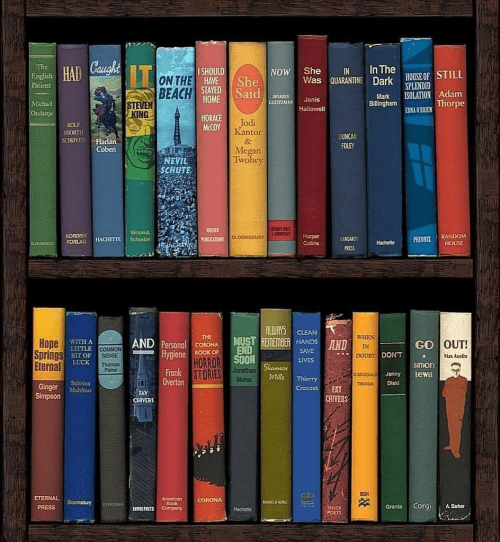
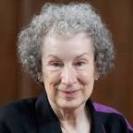 I read a great essay a few days ago in the Guardian by Margaret Atwood about some of the unusual things she’s doing in this time of isolation. She’s such a witty, clever writer that if she wrote about the proverbial telephone book it would be worth reading. In this essay, titled
  My calendar, which has been pretty empty, is now filling up with these event mice, some of which I quite enjoy so I thought I’d tell you about some of them. I have a reservation for a book discussion this week at
 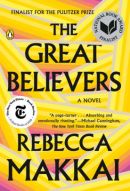 I also signed up for a “writerly chat” this evening between Rebecca Makkai and Jean Hanff Korelitz. Makkai is the author of
  The Film Society of Lincoln Center is streaming a movie this week that is a delight to watch. It’s called The Booksellers and it’s about the antiquarian book trade. Ho hum, you think. Not at all. It’s a lively and engaging look at the people who are passionate about hunting down, collecting, and selling old and rare books. There’s some history, some of it referencing Book Row, the stretch of Fourth Ave. in New York that housed dozens of antiquarian bookshops from the 1890s to the 1960s. Most of the film consists of interviews with book dealers: how they got into the business, what they love about it, and their thoughts about how it has changed and where it’s going. Fran Lebowitz provides some funny interludes. These collectors are interesting, thoughtful folks; you will probably feel differently about rare books after seeing this film. And, if you haven’t seen the movie Bathtubs Over Broadway, another film about collecting, now is definitely the time to stream it from Netflix.
 . The reader sees it from the point of view of Cromwell who is thinking about the events that led up to this day: the political intrigue and the trial. Mantel provides a few details about the gruesome event as Cromwell takes it in. In successive chapters she circles back to Anne repeatedly, so the reader has an ever-increasing awareness of the execution’s brutality and its emotional impact. It’s exactly the way it would happen: you take in what you can at the time, then it comes back to haunt you and you see more.
 In 1848, a small group of women gathered in the Seneca Falls, NY home of Mary M’Clintock. Their goal that Sunday morning was radical: to set in motion a movement to obtain the vote for women. Lucretia Mott and Elizabeth Cady Stanton, who went on to devote their lives to the movement, were among them that day. The women noticed that it was 72 years since the Declaration of Independence was published and they decided to use that document as the template for their own call for suffrage.
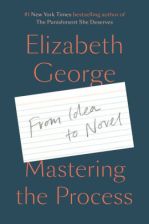 I know there are writers among the readers of this blog and I keep an eye out for interesting articles about the writing life.
  We all have stories to tell–sometimes they haunt us and sometimes they keep us going. Sometimes they’re powerful and sometimes we think they’re unexceptional. But sharing stories is a way to find out what other people think and feel.
 A Reader's Place