
I have to confess I’ve been in a reading slump. I start a book and then wonder if it’s worth my time. I close it and go on to another and then have the same experience. I just closed Emma Straub’s new book, This Time Tomorrow after reading about sixty pages. Sigh; I’ve liked her other books very much, especially All Adults Here and Modern Lovers. This one was too slight for me right now. A friend gave me The Midnight Library by Matt Haig and I closed that one too.
 So what has caught my attention? My older son recommended The Crossing by Cormac McCarthy. I hadn’t read any of McCarthy’s books before, tried The Road, but was put off by the incredible bleakness. The Crossing is also bleak, but it’s very haunting. I felt literally sucked into the story, grim though it was. The plot is minimal, the dialogue cryptic, so the reader needs to concentrate to get the juice out of what’s going on. The characters’ motivations are opaque: never stated, only felt. It’s about two brothers, Billy and Boyd Parham, and the trips they make from New Mexico to Mexico in the 1930s. I won’t say more; it’s quite an experience to read it. My son says it’s the best of the three books in McCarthy’s Border Trilogy and he’s pretty reliable about literature, but I may still pick up the other ones.
 I also enjoyed The Colony by Audrey Magee. The characters and setting are unusual and the author tackles some interesting issues of cultural appropriation in a novel way. It takes a while for the story to warm up. Mr. Lloyd, an artist, comes to an isolated island off the coast of Ireland to spend the summer painting the beautiful cliffs. He’s channeling Gauguin, hoping to go off in a new more naturalistic direction that will catch the London buyers. His wife, a gallerist, won’t sell his works anymore or share his bed. The local folks have agreed to rent him a cabin and provide food. Lloyd is joined by a French linguist, Mr. Masson, who is surprised and annoyed to find the artist there. Masson is studying the Gaelic language on the island and is worried that speaking English to Lloyd will corrupt the islanders’ language. Two cranky, disappointed men face off in this short novel of ideas. The islanders are more appealing, especially the teenage James, who may be a better artist than Lloyd.
 Last month I was listening to one book and reading another and since they were both about families and adultery it was a little head-banging to go back and forth. One was Monica Ali’s new book
  I’ve always wondered just how fish developed into land creatures, or, put another way, how humans developed from fish. Yes, I know it took millions of years, but what were the intermediate steps? That’s the subject of
  The title of Jonathan Franzen’s latest novel is very apt–all the characters are at crossroads in their lives and every chapter ends with another messy situation so the reader is repeatedly reminded of the title. In some cases, a character is literally at a crossing in the road at the end of a chapter. The story is told by five members of the Hildebrandt family, and it’s set in the early 1970s in a suburb of Chicago.
 The highly anticipated new novel by Joshua Henkin,
  I read A Nearly Normal Family by Swedish author M.T. Edvardsson in two days, a psychological thriller about a family whose teenage daughter is accused of murder. Stella has always been a difficult child with a terrible temper and a lack of impulse control, but could she murder someone? The story is told in three parts; first by the father, then by Stella, and last by her mother. Unreliable narrators and complicated family relationships move the story forward. The novel poses the question: how far would you go to keep your child out of jail whether she’s guilty or innocent? Would you know if she was guilty? Would it matter?
 There have been several biographies and histories about women spies and resisters in World War II. It’s often hard to know what precipitates these mini-trends. I’ve read and enjoyed several of these books (links to them at the end of this post), but the one I read most recently is
  The full title of this book is
 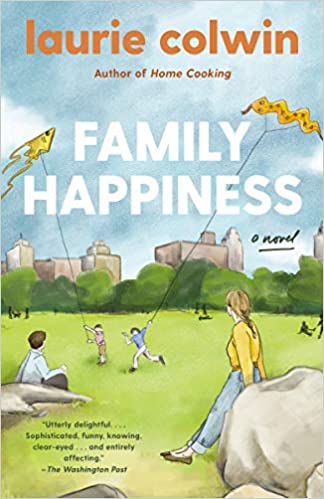 Just a short post to say that I just heard the good news that Laurie Colwin’s books are going to be re-released by her publishers. Colwin, for those of you who haven’t had the pleasure of reading her novels, short stories, and cookbooks, was a very special writer who died much too young. Her tone was a little arch, a little knowing, but never cloying. She wrote about our lives and the unexpected things that bring us happiness. Start with any of her novels, like Family Happiness or A Big Storm Knocked It Over. She wrote regularly for the New Yorker and Gourmet–her food writing is elegant and delightful. (I used to make her black bean soup recipe.)
 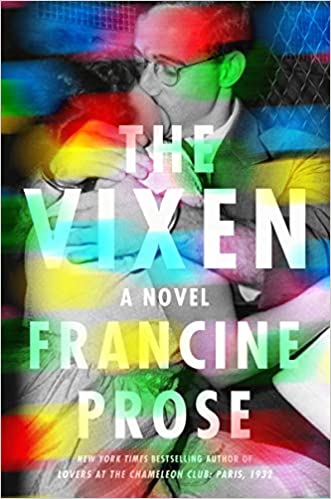 Prose’s new novel is nested: several stories resting uncomfortably together. It’s not uncomfortable for the reader, just for the main character, Simon Putnam. Poor, naïve Simon, just out of Harvard with a major in folklore and mythology, of all things. The novel’s set in1953: Joe McCarthy’s HUAC hearings are in full swing and Ethel and Julius Rosenberg have just been executed for passing secrets to the Russians. In the opening prologue, Simon and his parents (who knew Ethel Rosenberg) are watching Ethel’s execution on TV in their Coney Island apartment. Prose’s juxtaposition of their banal conversation and the horrific event is a brilliant piece of writing.
  A Reader's Place