Category Archives: Uncategorized

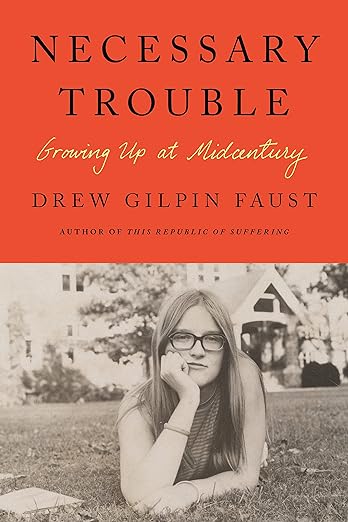
Necessary Trouble by Drew Gilpin Faust

Necessary Trouble

You may recognize the title of this book as part of a quote from the incomparable Civil Rights activist John Lewis. The phrase refers to the important work of upending racial discrimination. Lewis practiced raising “necessary trouble” all his life. He was an active force in the Civil Rights movement beginning in the 1960s and served in Congress from 1965 to his death in 2020.

“Thank you for getting into trouble, necessary trouble” is one of the epigraphs in Drew Gilpin Faust’s new memoir Necessary Trouble: Growing Up at Midcentury. It was Lewis’s comment to her on reading Faust’s memoir. She, too, participated in the Civil Rights movement and spent her adult life probing the events of the Civil War and its aftermath. She grew up in the horse country of northern Virginia in the 1950s, a rebellious daughter who disdained the Southern Belle upbringing her mother wanted for her. She was much more attracted to the free and independent life her brothers were allowed. But, “it’s a man’s world,” her mother always told her, “and you’d better get used to it.” She fought with her mother all her life over what was appropriate behavior. She writes that “…we never settled the larger part of the argument that was what we had instead of a relationship.” Necessary Trouble is a coming-of-age memoir from a time (the 1960s) when coming to maturity meant abandoning the mores and strictures of our mother’s lives and plunging headlong into another world.

At the age of nine, she wrote to President Eisenhower asking him to address the issue of equal rights for African-Americans. From an early age she disliked the inequality she saw growing up. A photocopy of her letter is on the opening pages of the book. She was lucky to attend schools that encouraged women and gave them the freedom to follow their interests and their passions.

During her college years at Bryn Mawr she spent the Freedom Summer of 1964 traveling in the South with other students; she skipped midterms to protest the Vietnam War; and she became a historian of the Civil War to understand the origins of U.S. racial justice issues. Faust and I are almost the same age so I enjoyed the chapters on the social history of the 1960s. They were such turbulent times! Her succinct and evocative description of what it was like to live through those times brought it all back for me. Faust brings her memoir up to the year 1968. There’s certainly more than enough to enjoy and think about in what she’s written but I suspect that at some point she’ll take us further. She was, after all, the first woman president of Harvard, from 2008 to 2018 and the author of several acclaimed books on the Civil War, including the outstanding This Republic of Suffering: Death and the American Civil War.

Several months ago I had the pleasure of hearing Faust speak about her life and her memoir to a full house at the incomparable Labyrinth Books in Princeton. She was interviewed by former Princeton president Shirley Tilghman, another brilliant, formidable woman. The room was full and there was a wonderful sense of ease between them, these women who had accomplished so much. There was no posturing, just a genuine sense that there was so much to be done and they were so glad that they had had a part in it.
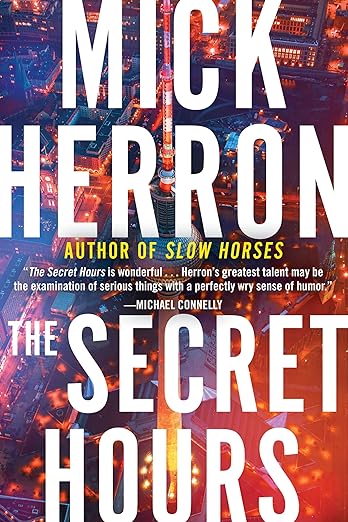
  

The Secret Hours by Mick Herron

Secret HoursI’m a big fan of the Slough House series and have read or listened to them all with great delight. Mick Herron’s plots about MI5 agents are satisfactorily convoluted and the characters are well distinguished from one another by their quirky–sometimes loathsome–personalities and politics. His new book, The Secret Hours, a standalone MI5 thriller, is related in plot and character to the Slough House books and filled with the same cloak-and-dagger intrigues, betrayals, and clever writing. Some of the current Slough House characters show up in earlier time periods so we finally learn their backstories although since they all change names as they move through their careers, Herron keeps readers guessing. The writing, as always, is witty and hilarious. Here’s an example, a description of the participants attending an oversight committee meeting:

“One or two were capable of independent thought, but when the whip came down, none would throw themselves in front of a foregone conclusion. All over Whitehall, the matchstick remains of once promising careers warned of the consequences of doing that.”

The book opens with the botched abduction of Max, a sixty-something former spook who’s been hiding in plain sight in a remote village in Devonshire since the nineties. The plot travels back and forth between today and 1994 to unravel the reason for his abduction, with Herron’s usual inter-office intrigue and backstabbing. Like the Slough House series, the main characters–Griselda and Kyle–are stuck in a backwater doing pointless, repetitive work until they stumble on the juicy nugget of Max’s history. Who sent them this file and why? Griselda and Kyle know they are putting their admittedly second-rate careers in jeopardy, but they long to do something that will put a sharp stick in the eye of the superiors who exiled them to the meaningless project Monochrome.

Flashbacks to Max’s spy days in Berlin reveal the earlier history of Jackson Lamb, the character that Slough House fans love to hate. (He’s brilliantly played by Gary Oldman in the Apple TV series). David Cartwright, grandfather of River Cartwright–everyone’s real favorite character–also plays a role. You don’t need to have read the other Slough House books to enjoy this one, but if Herron’s special brand of the cerebral and ribald appeals to you in this book, the Slough House series awaits.

A Very Big Read

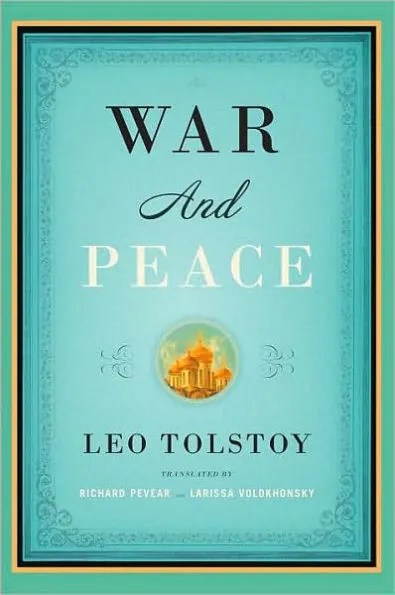
War and PeaceI don’t think it’s possible to read War and Peace in a casual way. It needs time, lots of time, and commitment. Also, it requires a good translation that helps the reader with the French passages, provides historical notes and the all-important list of characters. I had been eyeing War and Peace for years, but it wasn’t until a few years ago, when I saw the Sergei Bondarchuk film, made in the Soviet Union in the 1960s, that I thought I would give it a try. Watching that wonderful film (in three parts, many hours long) gave me an easier entrée to the story. Or maybe, now I didn’t have to read it. Was the film enough? Several years passed and it was always in the back of my mind: to read or not to read. And then I did it, signed up for a course to read War and Peace in eight weeks with twenty other folks and two discussion leaders. Some people in the class had read the novel before, others, like me, had never read it. One woman had read it three times!

Our assignment for the first class was the first two hundred pages. I started writing this post when the course began, last spring, sure that I would keep up every week with the novel and my reactions. Procrastination took over! Now it’s six months later. The same discussion leaders are planning a class on The Brothers Karamazov in the spring–another Russian classic I never read. The discussions we had about War and Peace were so terrific that I think I’ll sign up for this next one.

Back to War and Peace. Tolstoy starts in medias res: we’re at a soiree at the home of an upper-class noblewoman, Anna Pavlovna. It’s an easy way to introduce lots of characters, have them express their opinions, and describe them as they enter the party. Napoleon is already on the march, winning battles as he heads towards Moscow. The guests admire him as a heroic soldier but revile him for his assault on Russia. Tolstoy has little use for Napoleon; he appears in the battle scenes as a buffoon. And Tolstoy repeatedly addresses the reader; he wants to make sure that we understand his point of view about history and who gets to tell the story.

There’s lots of up-close history in the novel and those parts are very exciting, but the personal stories of Natasha, Pierre, and Andrei are the beating heart. There are villains and heroes, characters change and grow and we get to live with them and share their travails. Pierre, a lost soul, inherits a huge fortune and becomes an object of desire for a beautiful but depraved and unscrupulous woman. Reader, he marries her, and we ache for Pierre’s mistake. He was my favorite, a tormented soul until…but I won’t give away what happens to Pierre. War and Peace encompasses so much and draws you in very close to the characters. I wouldn’t want to spoil that.

I recently saw a student production of Natasha, Pierre, and the Great Comet of 1812, a musical version of a chunk of the book. I loved revisiting the characters, thinking once again about their complicated lives and loves. If you need a book for those short, gloomy winter days, open up War and Peace and join the party at Anna Pavlovna’s.

The Contributions of Women

roz-w-phoneI was at an exhibit a few weeks ago at Morven–the historic house and museum in Princeton–to see an exhibit about the Bell Telephone Company, whose history is so much a part of twentieth-century New Jersey. The exhibit was especially focused on Bell Laboratories, the R&D arm of AT&T, which has a distinguished history of innovation in the field of telecommunications. Having lived in Monmouth County for many years, I was very much aware of the presence of Bell Laboratories locations all over the county and the milestones in telecommunications that took place there. The first ship-to-shore transmissions took place near the shore and the first transatlantic telephone call was made from Deal Test Site, now a park where you can see the remnants of the old buildings where the research was done. Marconi ran tests in transatlantic radio telegraphy from Atlantic Highlands at the northern end of the Jersey Shore.
Like many large companies in the previous century, diversity in hiring staff at Bell Laboratories was not company practice. No Jews were hired until after World War II and no Blacks were hired until the 1970s. (Bell Laboratories was founded in 1925.) The exhibit at Morven had several panels about the diverse staff who enriched the company’s research and culture. I was very interested in one particular panel about Marion Croak, a Black woman who joined the Labs in 1982. It is quite astounding to me that her name is not more well-known. Here’s the blurb that was next to her photograph:

“Marion Croak began her career at Bell Labs…in the Human Factors research division. She became interested in converting voice data into digital signals, which would allow people to speak via the internet instead of telephone lines. This Voice over Internet Protocol (VoIP) technology allows the videoconferencing that has become commonplace. Today she is a Vice President of Engineering at Google. She holds over 200 patents.”

So there’s no specific book attached to this post, but just a reminder that women’s contributions, and minority women in particular, rarely get the attention they deserve. Lately, there have been a number of books reminding us of this. I probably don’t have to mention Hidden Figures: The American Dream and the Untold Story of the Black Women Mathematicians Who Helped Win the Space Race, and there’s been a spate of books recently about women spies in World War II: American, British, French, and Russian. In researching Marion’s biography, I found that she was inducted into the Women in Technology International Hall of Fame, a site worth looking at.

Correction: The first Black employee at Bell Labs was the engineer W. Lincoln Hawkins. He was hired in 1942.

Here’s a short bio of his career there; the link to the bio is at the end.

“The first Black scientist at Bell Telephone Laboratories in 1942, he had a long and distinguished career as a chemist. His most important innovation was as co-inventor of an additive to stabilize the plastic protective covering of telephone cables, a process that has saved billions of dollars for telecom companies around the world. In addition to 14 U.S. and 129 foreign patents, Hawkins was the first Black inventor to be inducted into the National Academy of Engineering and received the 1992 National Medal of Technology. Hawkins long served as a mentor to young minority researchers. He retired in 1976.” https://life.att.jobs/article-distinguished-black-inventors-history/#:~:text=Lincoln%20Hawkins,distinguished%20career%20as%20a%20chemist.

Till the Wheels Fall Off by Brad Zellar

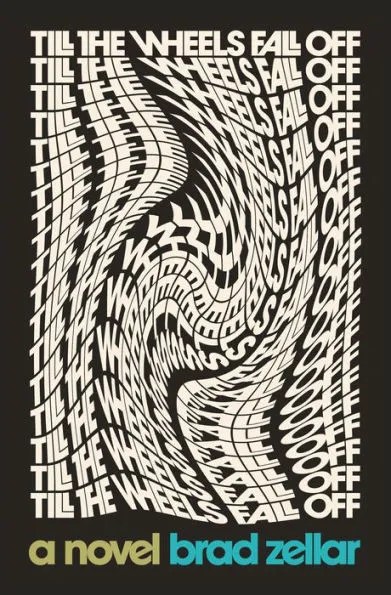
Till the Wheels Fall OffThe other day I was taking a drive with a friend back to my old neighborhood and we passed a sign, one of those huge LED signs powered by a generator, that announces upcoming roadwork or detours. As I approached it and passed it, the sign broadcast only one message: “FIND ALTERNATE ROUTE.” Was it trying to tell me something?

“Find alternate route” certainly could be the mantra for the main character in Till the Wheels Fall Off by Brad Zellar, a book that takes a deep dive into the insomnia- and ADHD-raddled brain of Matthew Carnap, from childhood into adulthood. When the book opens, Matthew has returned to his dying hometown, Prentice, Minnesota, after trying his luck in the Twin Cities and not doing so well. Matthew’s father died in Vietnam before ever seeing his son, and Matt’s been raised in Prentice by his single mom, with help from his Dad’s brothers, especially Rollie Carnap. Matt’s mother has never recovered from the death of her husband and is well-meaning but inattentive. The heart of the novel is the five years in the 1980s that she spent married to Russ Vargo, who owned Screaming Wheels roller rink. Matt and his mother moved into the small apartment behind the rink. Claustrophobic, certainly, but Matt and Russ developed an intense bond over the music at the rink.

Russ is obsessed with the music of the 70s and 80s, making mixtapes and playing them from the High Tower above the rink and after hours as well, skating late into the night to the sounds of his favorites. He can’t get enough. The nine-year-old Matt, happy to have someone paying attention to him, becomes Russ’s disciple; the music becomes his obsession as well. That’s not a bad thing but it does prevent Matt from thinking about what his life might be like after high school. He hangs around with a stoner named Greenland but manages to avoid trouble. Russ and his mother divorce, leaving Matt feeling stranded and alone once again After high school, for five years he takes to the road in his uncles’ business servicing coin-operated condom machines around the Midwest before giving up the “rubber route” and landing a writing job in Minneapolis.

When he returns to Prentice in his late twenties, empty-handed and depressed, Uncle Rollie sets up an apartment for him in the press box of the high school football stadium. It’s a good start for Matt in putting his life back together. I won’t tell anymore about what happens in the last third of the novel. The writing is wonderful and evocative, nostalgic and full of longing. The Kirkus reviewer said it had “lots of sentence-level snap” and I agree. It was a pleasure to read.

There isn’t much plot until the end and the novel is filled with playlists and Russ’s judgments about which bands are worth listening to. I’ve rarely read a book that does such a good job of conveying the power of popular music on our brains. High Fidelity by Nick Hornby comes to mind, of course, but also Daisy Jones & the Six by Taylor Jenkins-Reid. And especially the memoir Love is a Mixtape: Life and Loss, One Song at a Time by the music critic Rob Sheffield.

An antidote to anxiety

Zebra on right has something to say.I thought I’d pass this along for those days when you can’t seem to get out of your own way to accomplish the tasks that seemed so incredibly important when you went to sleep the previous night. My friend Pnina sent it to me a few months ago and I printed it out and posted it near my desk. I didn’t ask her about the origin, but I’m sure she’ll tell me when she sees this post! (Photo by Gerald Reisner)
I am reading a mystery novel

I am collecting my thoughts

I am contemplating my future

I am remembering things past

I am so happy to be in my room

I am trying to concentrate

I am enjoying a pastry

I am being inspired by a book

I am listening to my music

I am planning my evening out

I am watching a great film

I am thinking about a career change

I am meditating

I am reflecting on my decisions

I am tasting a glass of wine

I am enjoying my tea

I am stimulating my curiosity

I am writing a love letter

I am dreaming of a bright tomorrow

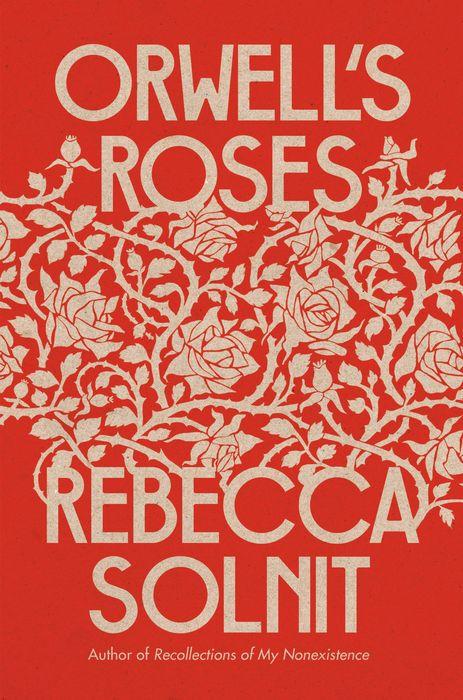
Orwell’s Roses by Rebecca Solnit

Orwell's RosesI’m a big fan of Rebecca Solnit’s writing about social issues (Call Them by Their True Names, Men Explain Things to Me, The Mother of All Questions) and when I read the reviews of Orwell’s Roses it sounded very different from those books. Was it really about the roses Orwell planted in his garden? As a person with a black thumb, did I want to read about gardening? But I know that for a writer like Solnit, almost anything can be a jumping-off point for insightful social commentary. The book does indeed start with the roses that Orwell planted in his garden in Wallington, England. Solnit spins off into Orwell’s life and political thought but always circles back to the meaning of roses, for Orwell and for all of us. You will be surprised and enlightened, as always, by her writing.

And then there’s Orwell’s own commitment to writing well. Solnit quotes him: “But I could not do the work of writing a book, or even a long magazine article, if it were not also an aesthetic experience. Anyone who cares to examine my work will see that even when it is downright propaganda it contains much that a full-time politician would consider irrelevant. I am not able, and do not want, completely to abandon the world view that I acquired in childhood. So long as I remain alive and well I shall continue to feel strongly about prose style, to love the surface of the earth, and to take a pleasure in solid objects and scraps of useless information.” Solnit writes that the passage above “has long served me as a credo…Clarity, precision, accuracy, honesty, and truthfulness are aesthetic values to him, and pleasures.”

Solnit led me to one of Orwell’s essays about writing, “Politics and the English Language,” about obfuscation and fuzzy thinking. It’s a timeless piece that every writer should read.

I borrowed a library ebook of Orwell’s Roses but decided that a hard copy was necessary so that I could re-read some of the chapters, and think about the ideas without an expiration date hovering over my enjoyment of the book. It was well worth the price.

The Latecomer by Jean Hanff Korelitz

LatecomerA recent New Yorker cartoon shows a teenage girl shouting at her mother: “Nature or nurture, it’s all your fault!” Jean Hanff Korelitz’s new novel is about nature and nurture, how we chart our own way in the world despite our families, and many other subjects as well, but not in the way you might expect. The well-known Philip Larkin poem, “This be the Verse” is apropos. Readers of Korelitz’s last novel, The Plot, will remember how she skewered the writing trade. The satire was hilarious and the main character’s comeuppance at the end was delicious. The Latecomer is also filled with satire, but the novel is more character-driven. It’s about the Oppenheimer family–parents and three children who spiral away from each other in wider and wider arcs and a fourth child, who, well, let’s just say she changes the dynamics. Read it and find out.  
Two events set the novel in motion. The first is a car accident, the second is infertility. The accident saddles Salo Oppenheimer with a crushing burden of loss and guilt that his wife Johanna does her best to alleviate. Johanna, desperate for the liveliness of family to fill their large Brooklyn Heights house, decides to try in vitro fertilization. After many failures, three of four viable eggs are implanted in Johanna’s womb. The fourth one is frozen, just in case. All goes well this time, and Johanna and Salo are the parents of triplets Harrison, Lewyn, and Sally. But the triplets share only their gestation in Johanna’s womb; once they are aware of each other’s presence, intense disdain drives them apart. This is not a happy family. Johanna is devastated and Salo, unable to engage, retreats into his own world of art collecting and guilt. When the triplets go off to college, Johanna remembers her last (frozen) egg and decides to take one more chance at a happy family. Phoebe is the fourth Oppenheimer child, the eponymous latecomer. 

This is a difficult book to summarize; there’s lots of plot and intense character interaction. I haven’t mentioned the satire that permeates the story, skewering liberals and conservatives alike. Mormonism, hoarding, art collecting, chickens, Cornell, and progressive private schools all make significant appearances. New York City is summoned up in a most satisfying way. Many readers will recognize quotes and references to other books. In the middle, you’ll wonder where it’s all going, but Korelitz ties it up nicely. Will the Oppenheimers ever be content to be part of the same family? That’s what kept me turning the pages. 

Other complex family novels that I’ve enjoyed: 

Commonwealth by Ann Patchett

The Year We Left Home by Jean Thompson

We Were the Mulvaneys by Joyce Carol Oates

The Children’s Book by A.S. Byatt

and, for those of you who need an absorbing thousand-page novel, one of my all-time favorites, A Suitable Boy by Vikram Seth


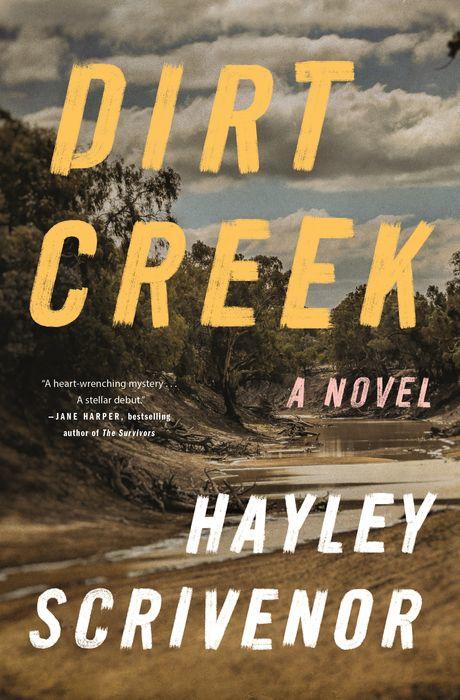
Dirt Creek by Hayley Scrivenor

Dirt CreekI’m sure you’ve all read–or read reviews of–those novels where a young girl goes missing. It’s become a sub-genre of domestic fiction and coming-of-age novels. When I read a good review of such a book I sigh. Do I have to read this one? Well, yes, I did have to read the brand-new Dirt Creek because it’s set in Australia. For me, Australian noir has replaced Scandinavian noir. Trust me on this. It’s a long way from the bitter cold and long nights of Nordic mysteries to the sun-parched, drought-ridden, cheerless towns of the outback, but it’s a trip you need to take. I’ve appended, at the bottom of this post, a few other titles I’ve enjoyed in recent years. I’ve been to Australia and it seemed like a cheery place, full of those funny greetings (G’day mate!) and strange animals, but hey, what does a tourist know about the dark corners?
There are the familiar tropes in Dirt Creek: a popular twelve-year-old girl goes missing; her friends and their families have secrets they keep from the authorities; a policewoman with her own issues is sent from the big city to solve the crime. Scrivenor’s success with these familiar plot devices comes from the characters she creates and the narrative structure. Esther, the girl who goes missing, is more than just a good friend to Ronnie and Lewis, outsiders in their school. She’s the one who makes them feel safe and understood. Their parents and extended families are a mess. Their town, called Durton–dubbed “Dirt Town” by the teens–lives up to its name.

Each chapter focuses on a different character, building a picture of the town along with relationships and motivations. One of the characters speaks in the first person and there are chapters in the third person as well, kind of a chorus of the town’s children, whose voices reflect, look back, and create tension. Here’s an example from one of the third-person sections: “We understood, even then, that bad things happened. And we understood that sometimes people made them happen, sometimes those people were close to us, or even ourselves.”

But more than that, Scrivenor locates emotions in the bodies of her characters, describing exactly how events made them feel: the stone lodged in the stomach, the sensation of choking, the claustrophobia in the lungs. We know that Esther won’t come back, but it’s the way each person is bound up in the story that makes it so compelling.

Other Australian noir that I’ve read and enjoyed:

The Dry by Jane Harper. Flatiron Books, 2017. (now a movie) This was the first book in the detective Aaron Falk series.

Force of Nature by Jane Harper. Flatiron Books, 2018. Second book in the Aaron Falk series. (The third in the series, Exiles, is coming out in January, 2023.)

Scrublands by Chris Hammer. Atria Books, 2019.

Breath by Tim Winton. Farrar, Straus, and Giroux, 2008.

Paperbark Shoe by Goldie Goldblum. Picador, 2011.

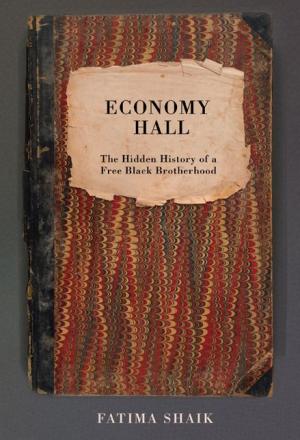
Economy Hall: The Hidden History of a Free Black Brotherhood by Fatima Shaik

Economy HallIn pre-pandemic times, I used to meet occasionally in the evenings with several women at the cafe French Roast in Greenwich Village. A glass (or two) of wine, maybe a salad or tartine, and good conversation. It’s not so easy these days to meet people in a casual way and I miss those gatherings. One of the women at those French Roast gatherings was Fatima Shaik, the author of Economy Hall. I’ve been remiss in not writing sooner about this book, since I had the pleasure of interviewing Shaik for the Women’s National Book Association several months ago. She used to tell us about the years she spent doing research for a history book about New Orleans and how she had become immersed in the story. I knew I’d read it once it was published.

Economy Hall is indeed an immersive book and I understand why Shaik spent all those years uncovering the history of the group. It was a vibrant organization in the Treme district that served as a social club; a support network; an educational and charitable organization; and a way for the Creole community to display its learning and unique style. Many of the founding members came from Haiti, where they had been involved in uprisings. They spoke several languages, appreciated music and literature, and enjoyed good food. New Orleans didn’t want these rebellious Blacks, but they came anyway and created a vibrant free Black community. It’s quite a story, from Economy Hall’s founding, in the 1830s, to the 1950s when it had a second life as a popular venue for jazz. Detailed minutes–which Shaik’s father wisely rescued from the trash–provided a wealth of information but also difficult choices about how to present the material.

How does a writer decide when the research is done, when there’s enough information to tell the story? Which of the thousands of details and anecdotes are needed to invigorate the tale? And from whose point of view should the story be told? Shaik decided to let one of the members of Economy Hall tell the history: Ludger Boguille, an early member with ties to Haiti. For many years Boguille was the recording secretary, taking minutes of the meetings–in French–in a beautiful, almost calligraphic hand. Focusing on an individual was a great choice to bring the reader right into the life of the Society: the friendships, the fabulous social events, the feuds among members, and the painful striving for recognition by the white community.

It’s a great story, well told and I highly recommend it!