Monthly Archives: November 2009

Weekends at Bellevue

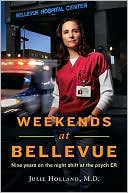
When I was growing up, the name “Bellevue” was shorthand for the hospital that took in the crazies. Reading Julie Holland’s new memoir, Weekends in Bellevue: Nine Years on the Night Shift at the Psych ER I learned that it still has that reputation. It’s the place where the police bring the naked guy who’s barking like a dog in Times Square, along with the bridge jumpers, the violent schizophrenics, and the ones feigning psychosis in order to get a meal and a warm bed. Holland, a psychiatrist, was always drawn to the extreme cases and enjoyed working two fifteen hour shifts each weekend to have the week off with her family. Her cool-girl, tough talking exterior served her well, or so she thought, with patients who were verbally and physically violent until she realized she wasn’t coping with the pain those traits masked. My favorite medical memoirs combine good storytelling with insight about the teller; Holland does both those things well.
I’ve put together a list of additional memoirs by doctors that I think are particularly interesting.
Memoirs for discussion, continued…

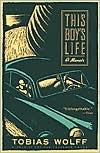
I was delighted to see a post about my book on Book Group Buzz, the Booklist blog, especially since I’ve just been thinking about the qualities that make a memoir appropriate for book discussion groups. For me, it’s the relationship between character and story. If you’ve read This Boy’s Life by Tobias Wolff, you’ll know what I mean. Wolff writes about his teenage years, when he’s trying on identities, giving in to bad impulses, hanging out with the wrong crowd but also dealing with his divorced mother and the series of wildly unsuitable stand-in fathers she lives with. His mother loves him, but she’s clueless about the appropriate way to bring up a child. His real father is a con artist who’s never on the scene. Wolff learns to define himself in opposition to his stepfather, making bad choices along the way, but he always has a dream, a core of himself that’s inviolate. Somehow he believes that despite his wildness, his acting out, he will escape unscathed into a better place; he’s somehow smarter, better, destined for other things. His memoir is far more than the recounting of abuse and bad choices that fuels so many dysfunctional family memoirs. Wolff’s self-awareness, his ability to make us understand how he fought to invent himself,  and the way he uses humor to defuse and describe the most scary and poignant episodes give This Boy’s Life depth and style. It has always intrigued me that Wolff’s next book, Old School, picks up where This Boy’s Life leaves off, but the story continues as fiction. Hmm, now wouldn’t that be interesting for a book group–to read and discuss those books together.
I’ve put together the first of several reading lists of memoirs that I think book groups would enjoy discussing. It’s  .pdf so you can print it off and take it with you.


Memoirs for book discussion groups

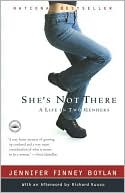
At my book group, one of the best discussions we had was about the memoir She’s Not There: A Life in Two Genders by Jennifer Finney Boylan. We couldn’t stop turning it around, looking at it from various angles. It’s filled with great storytelling and wonderful set pieces about family and friends that are funny and emotionally piercing. Boylan is writing about her sexuality, the way she knew from age 3 that she was trapped in the wrong body, but while there’s pain and struggle to her story, it’s a joyous, eye-opening book.
There are so many memoirs that are ideal for book group discussion. I just did a Q&A session on this topic for the blog at ReadingGroupGuides.com with Shannon McKenna Schmidt, so you’ll find title suggestions there. There’s an icon in my book, Read On…Life Stories to identify memoirs that are good for book groups. I’ll come back to this topic in the next few weeks with more titles of memoirs that are great for discussion.

Teens Need to Read Memoirs, Too

I read so many wonderful memoirs over the course of writing Read On…Life Stories, and a number of times I thought about how much I would have enjoyed many of these books as a teenager, how the stories of real lives are comforting, inspiring, enlightening, informational and often deeply satisfying because we know they’re written by the people who lived the experience. They’re heartfelt. I’ve posted a list of some memoirs that I think teens would enjoy–try them out on teens you know!

I’m not denying/ignoring the power of fiction here, which we all know, is undeniable. Certainly fiction can provide some of the most powerful reading experiences of our lives, but a good memoir is never a dry recounting of facts, a great memoir is literature, like fiction. A good memoir has a beginning, full of exposition and character development, a middle, often with climactic events, and an ending that ties up what came before, often with a satisfying resolution. If you think about Angela’s Ashes—that certainly is a piece of literature with all those qualities. We know that in fiction a writer has used memory, experience, and imagination, all the tools of creative writing. What we sometimes forget, is that memoirs are also shaped by these same literary devices.

There’s also a lot to be said for reading the right book at the right time. The teen years are a time when we need to read the right books–we need guidance from wherever we can get it! Memoirs and autobiographies, stories of real lives by the people who lived them—and survived to tell the tale—can help teens navigate a formative period when they need a bridge to the adult world. Many memoirs are coming of age stories that specifically deal with those years where teens are trying on identities and trying to understand what seems like the secret language of the adult world.

There’s often raw emotion and vulnerability in memoirs, like the music teens listen to and the poetry they write. There’s also the fascination of reading about how the world looks through someone else’s eyes, from inside someone else’s skin.