Tag Archives: World War II

Question 7 by Richard Flanagan

It’s hard to know where to begin describing this book. It’s a memoir, but a memoir unlike any other I’ve read recently. Flanagan’s Question 7 interweaves stories and incidents from his life with descriptions of some of the most destructive episodes in human history, including the bombing of Hiroshima, the Holocaust, and the eradication of the native population in  Tasmania. Like the chain reactions in an atomic bomb, Flanagan builds to a moving, haunted climax by building his narrative around these events of ruin and loss.

Flanagan opens the memoir by describing his trip to the site of a World War II camp in Japan where his father had been interned as a slave laborer in a coal mine. Guides at the camp deny the existence of slave labor there. Flanagan writes, “Sometimes I wonder why we keep returning to beginnings–why we seek the single thread we might pull to unravel the tapestry we call our life in the hope that behind it we will find the truth of why. But there is no truth, there is only why.” His father’s experience has been erased; it’s one of several lessons in the power and fragility of memory.

In exploring the “why” of memory, Flanagan ranges over various subjects, starting with H.G. Wells’ prescient novel The World Set Free, written in 1913, in which Wells predicted the creation of a weapon of more destructive power than any previously known. Flanagan links Wells’ novel to the scientist Leo Szilard, who helped create the atomic bomb, but then, terrified by what he had done, tried to stop its use in Hiroshima. Chapters about Wells, Szilard, and other scientists and writers (including Vonnegut) circle around sections devoted to Flanagan’s childhood. The last chapter is the harrowing story of his almost-fatal kayak journey down the Franklin River in Tasmania when he was twenty-two. The trauma of that near-death experience–which is foreshadowed from the beginning–informs the entire book and connects to the story about his father’s experience in the slave labor camp. Time, memory, destruction, and literature are all woven together. I also now have a deeper appreciation of the way colonial history is embedded in the DNA of Australians and Tasmanians. Living “down under,” with its unique and savage history, ethnography, and geography, has had profound psychological ramifications.

Kirkus Reviews called Question 7 “a haunting, jagged, sparkling narrative puzzle in which the pieces deliberately refuse to fit.” That’s a great description of this ruminative, absorbing, and unsettling memoir. Flanagan leaves us with lots to think about.
My Father’s House and Ghosts of Rome by Joseph O’Connor

I’ve read lots of mysteries and thrillers about people caught up in World War II, so when I had the opportunity to read The Ghosts of Rome by Joseph O’Connor before it was published (thank you, Europa Editions!) I jumped at the chance. I read and enjoyed it, but Ghosts of Rome is the second in a trilogy, so I felt I was missing out on something. Were the characters first introduced in the previous book, My Father’s House? I needed to know. 

I’m glad I went back to My Father’s House. That’s where I met Father Hugh O’Flaherty and the other members of the “Choir” that he assembled to help Allied soldiers, Jews, and prisoners of war escape from the Germans. (In 1943, Italy surrendered to the Allies and the Germans moved in and occupied northern Italy, including Rome.) My Father’s House takes place in Rome from Christmas Eve to Christmas Day, 1943. The Choir plans to carry out a mission, a rendimento, to distribute money to the escapees they have hidden. Complex plans, coded messages, and help from the Fascist Resistance ratchet up the tension in a story based on historical figures. 

There are eight members of the Choir, all from different backgrounds and religious persuasions, connected by the intensity of their hatred for the Nazis who capture, torture, and kill with callous impunity. Vatican City is neutral territory, a safe harbor, but also a prison: the inhabitants can only leave with permission from Paul Hauptmann, the vicious commandant of occupied Rome, who is under pressure from Himmler to shut down the escape line. The fugitives have all been secreted in Vatican City in various underground crypts and tunnels. The Choir calls them “books” and their locations are “shelves.” 

The high-stakes cat-and-mouse game between O’Flaherty and Hauptmann makes this a page-turner. O’Connor intensifies the reader’s involvement through character development of all the Choir members. The writing has vivid phrasing and descriptions, especially of the bitter, icy weather. You’ll need a warm scarf and a cup of hot tea to read this one. 

Ghosts of Rome continues the story of O’Flaherty and the Choir, who, despite harassment from Hauptmann won’t give up their rescue missions. Because he has failed to stop the Choir, Himmler moves Hauptmann’s wife and children to Berlin as hostages. In this second part of the trilogy, Contessa Giovanna Landini takes the lead role in planning and executing the missions. The Countess, elegant and charismatic, is relentless in her efforts. Finding safe places for the “books” becomes more difficult and the escapees are restless, hungry, bored, and not always cooperative. The situation is complicated by the discovery of a downed airman, a member of the Polish Resistance, badly injured. He becomes a liability that tests their resolve and resources, one of many moral and logistical problems that the Choir wrestles with. 

As in the first book, O’Connor intersperses chapters with memories of the Choir members recorded some years later, which flesh out their characters and fill in the details of the missions. They become real to the reader and as we learn more of their own troubled histories, we’re invested in their survival. A young English girl named Blon, full of fire and determination, becomes crucial to the survival of the wounded airman, but she’s also a loose cannon, disobeying the Choir protocols and taking frightening risks. Dark, literary, and full of tension, Ghosts of Rome is a welcome addition to the canon of resistance thrillers. I’m  looking forward to part three of the Rome Escape Line trilogy. 

Other books about Italy in World War II that I’ve enjoyed: 

A House in the Mountains: The Women Who Liberated Italy From Fascism by Caroline Moorehead. HarperCollins, 2021 nonfiction. (I’ve read several books by Caroline Moorehead and enjoyed them all.) 

Alibi by Joseph Kanon. Picador, 2006.  (fiction)

A Thread of Grace by Mary Doria Russell. Random House, 2005. (fiction)

Bread and Wine Ignazio Silone. reprint. Penguin, 2005. Silone’s classic novel about resistance to Fascism is beautifully written. I read it in high school and still remember it. 

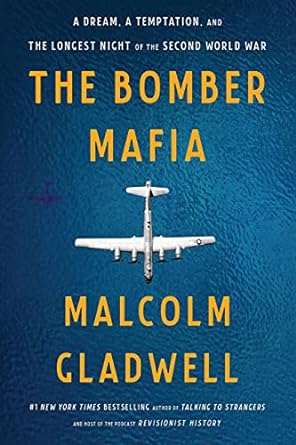
The Bomber Mafia by Malcolm Gladwell

Bomber Mafia

This is not my usual fare, although I do enjoy good war stories. A friend who’s doing research on the experiences of her father in World War II recommended it to me and I’m very happy she did. Gladwell tells the true story of a paradigmatic change in the U.S. Army Air Force before and during World War II. The Bomber Mafia was published first as an audiobook, complete with atmospheric music and sound effects, as well as clips of interviews with the main characters and military historians. Now it’s also available as a book, but I highly recommend the audio. It’s only about five hours and totally immersive. Gladwell is the narrator and does a sterling job.

The Air Force didn’t become a separate military service until 1947. During World War II it was part of the Army and called the Air Corps. In the 1930s, the military couldn’t figure out how airplanes were going to contribute to the next war; they saw them as support for ground troops. Maybe they’d need a few planes. However, a group of driven, idealistic, iconoclastic Air Corps pilots and officers had a vision that planes could take the place of ground troops by using high-altitude, daylight precision bombing. For their radical vision, they were known as the Bomber Mafia. They were brilliant, often eccentric officers; their personalities and disputes, plus Gladwell’s high-energy reading make it all very colorful and fun to listen to.

It was quite a stretch for the tradition-bound military services to accept this idea of high altitude, daylight bombing, but the Bomber Mafia persisted in trying to convince the generals. There was a new bombsight, invented by a Dutchman named Carl Norden, that had a high level of accuracy. It was a complicated analog computer that supposedly could put a bomb into a pickle barrel. If the Air Corps deployed this device, fewer pilots would be killed, fewer planes lost, and there would be fewer casualties on the ground. The Bomber Mafia thought the Norden bombsight was just the thing to win the coming war. The U.S. was the only country that had it. What could go wrong?

One of my uncles was a Seabee in the Navy, stationed on Tinian, part of the Mariana Islands in the Pacific that were used as bases to launch bombs against Japan. The Seabees built the airfields under enemy fire. There’s a family story about how his sister, my mother, sent him a jar of peanut butter. He turned up his nose and tossed it in the sand, but then crawled out to find it later when heavy shelling devastated their food supplies. After listening to The Bomber Mafia I now have a sense of what it must have been like for him. Haywood Hansell was the commander on Tinian, hoping to use the Norden bombsight for high altitude daylight bombing and validate the approach of the Bomber Mafia. He was sure Japan would surrender soon. It didn’t go so well for several interesting reasons, and he was replaced by Curtis LeMay, a traditionalist. LeMay had another approach that he was also sure was the right one.

I won’t tell any more of the details, except to say that Gladwell brings out the moral questions inherent in the story and the personalities of the principal protagonists (and antagonists). I’m pretty sure that if you start listening to this, you’ll be riveted to the end.