
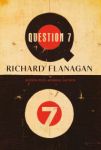
 It’s hard to know where to begin describing this book. It’s a memoir, but a memoir unlike any other I’ve read recently. Flanagan’s Question 7 interweaves stories and incidents from his life with descriptions of some of the most destructive episodes in human history, including the bombing of Hiroshima, the Holocaust, and the eradication of the native population in Tasmania. Like the chain reactions in an atomic bomb, Flanagan builds to a moving, haunted climax by building his narrative around these events of ruin and loss.
Flanagan opens the memoir by describing his trip to the site of a World War II camp in Japan where his father had been interned as a slave laborer in a coal mine. Guides at the camp deny the existence of slave labor there. Flanagan writes, “Sometimes I wonder why we keep returning to beginnings–why we seek the single thread we might pull to unravel the tapestry we call our life in the hope that behind it we will find the truth of why. But there is no truth, there is only why.” His father’s experience has been erased; it’s one of several lessons in the power and fragility of memory.
In exploring the “why” of memory, Flanagan ranges over various subjects, starting with H.G. Wells’ prescient novel The World Set Free, written in 1913, in which Wells predicted the creation of a weapon of more destructive power than any previously known. Flanagan links Wells’ novel to the scientist Leo Szilard, who helped create the atomic bomb, but then, terrified by what he had done, tried to stop its use in Hiroshima. Chapters about Wells, Szilard, and other scientists and writers (including Vonnegut) circle around sections devoted to Flanagan’s childhood. The last chapter is the harrowing story of his almost-fatal kayak journey down the Franklin River in Tasmania when he was twenty-two. The trauma of that near-death experience–which is foreshadowed from the beginning–informs the entire book and connects to the story about his father’s experience in the slave labor camp. Time, memory, destruction, and literature are all woven together. I also now have a deeper appreciation of the way colonial history is embedded in the DNA of Australians and Tasmanians. Living “down under,” with its unique and savage history, ethnography, and geography, has had profound psychological ramifications.
Kirkus Reviews called Question 7 “a haunting, jagged, sparkling narrative puzzle in which the pieces deliberately refuse to fit.” That’s a great description of this ruminative, absorbing, and unsettling memoir. Flanagan leaves us with lots to think about.
 A Reader's Place