
 I’ve read lots of mysteries and thrillers about people caught up in World War II, so when I had the opportunity to read The Ghosts of Rome by Joseph O’Connor before it was published (thank you, Europa Editions!) I jumped at the chance. I read and enjoyed it, but Ghosts of Rome is the second in a trilogy, so I felt I was missing out on something. Were the characters first introduced in the previous book, My Father’s House? I needed to know.
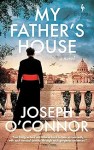
I’m glad I went back to My Father’s House. That’s where I met Father Hugh O’Flaherty and the other members of the “Choir” that he assembled to help Allied soldiers, Jews, and prisoners of war escape from the Germans. (In 1943, Italy surrendered to the Allies and the Germans moved in and occupied northern Italy, including Rome.) My Father’s House takes place in Rome from Christmas Eve to Christmas Day, 1943. The Choir plans to carry out a mission, a rendimento, to distribute money to the escapees they have hidden. Complex plans, coded messages, and help from the Fascist Resistance ratchet up the tension in a story based on historical figures.
There are eight members of the Choir, all from different backgrounds and religious persuasions, connected by the intensity of their hatred for the Nazis who capture, torture, and kill with callous impunity. Vatican City is neutral territory, a safe harbor, but also a prison: the inhabitants can only leave with permission from Paul Hauptmann, the vicious commandant of occupied Rome, who is under pressure from Himmler to shut down the escape line. The fugitives have all been secreted in Vatican City in various underground crypts and tunnels. The Choir calls them “books” and their locations are “shelves.”
The high-stakes cat-and-mouse game between O’Flaherty and Hauptmann makes this a page-turner. O’Connor intensifies the reader’s involvement through character development of all the Choir members. The writing has vivid phrasing and descriptions, especially of the bitter, icy weather. You’ll need a warm scarf and a cup of hot tea to read this one.
 Ghosts of Rome continues the story of O’Flaherty and the Choir, who, despite harassment from Hauptmann won’t give up their rescue missions. Because he has failed to stop the Choir, Himmler moves Hauptmann’s wife and children to Berlin as hostages. In this second part of the trilogy, Contessa Giovanna Landini takes the lead role in planning and executing the missions. The Countess, elegant and charismatic, is relentless in her efforts. Finding safe places for the “books” becomes more difficult and the escapees are restless, hungry, bored, and not always cooperative. The situation is complicated by the discovery of a downed airman, a member of the Polish Resistance, badly injured. He becomes a liability that tests their resolve and resources, one of many moral and logistical problems that the Choir wrestles with.
As in the first book, O’Connor intersperses chapters with memories of the Choir members recorded some years later, which flesh out their characters and fill in the details of the missions. They become real to the reader and as we learn more of their own troubled histories, we’re invested in their survival. A young English girl named Blon, full of fire and determination, becomes crucial to the survival of the wounded airman, but she’s also a loose cannon, disobeying the Choir protocols and taking frightening risks. Dark, literary, and full of tension, Ghosts of Rome is a welcome addition to the canon of resistance thrillers. I’m looking forward to part three of the Rome Escape Line trilogy.
Other books about Italy in World War II that I’ve enjoyed:
A House in the Mountains: The Women Who Liberated Italy From Fascism by Caroline Moorehead. HarperCollins, 2021 nonfiction. (I’ve read several books by Caroline Moorehead and enjoyed them all.)
Alibi by Joseph Kanon. Picador, 2006. (fiction)
A Thread of Grace by Mary Doria Russell. Random House, 2005. (fiction)
Bread and Wine Ignazio Silone. reprint. Penguin, 2005. Silone’s classic novel about resistance to Fascism is beautifully written. I read it in high school and still remember it.
 A Reader's Place