
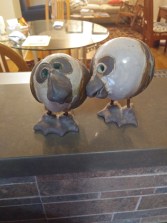
I‘ve been working on a memoir for the past year and thought I’d occasionally post some excerpts and thoughts about some of the content. Here, I’ve pulled together some passages about food. The picture refers to how we always tell our friends the stories of our lives, just like these two silly birds.
My beloved grandmother Flora grew up in the Catskill region of New York, eating prunes, potatoes, and herring for breakfast and waiting tables at the family hotel. She slept in her own grandmother’s bed until she was married. My mother, her daughter, grew up eating bowls of mashed potatoes and sour cream, brisket, and sponge cakes made with a dozen eggs. In her circle of friends, Flora was a well-known excellent cook. Really, as a wealthy lawyer’s wife, she trained the cook to her high standards. In the style of the times, Flora’s stoutness was evidence of prosperity and ignorance of cholesterol; she was zaftig. It was inevitable that after years of eating such rich food, Flora had a heart attack in her late fifties. She lived for another ten years, plagued by angina, bemoaning the fact that a slight wind in her face made her wheeze and stop for breath. In those days, stents and bypass surgeries were technologies far in the future.
Her daughter, my mother Rhoda, was an adequate but not creative cook; her repertoire consisted of fish once a week and a rotating cast of favorites, culminating in something called oven-fried chicken on Friday nights. Dinner always started with half a grapefruit with a maraschino cherry on top. There was no escape from the daily grapefruit; it set my teeth on edge. I was given portions the same size as my parents and when I couldn’t finish them, I was chastised. For a while, my mother would say, as she threw out my unfinished portion, that she was giving it to “your friend, the garbage pail.” I found those words so hurtful that I would become wild with fury.
Since she didn’t like to take time to do things properly, she wouldn’t wrap food well for the freezer. The hamburger meat had freezer burn and I found the burgers inedible. My parents couldn’t understand what I found so distasteful and insisted that I eat the two hamburgers on my plate. It wasn’t until I was married and cooking my own meals that I realized what she had done. One of my favorite family stories is about the fruit pies she used to buy at the A&P. She loved those pies. The first night we’d eat a slice at room temperature. Then it would go into the refrigerator. The second night she’d turn on the oven to warm up the pie. I always told her that I liked my pie cold. She liked it warm; how could I like it cold? I insisted that I didn’t like warm pie; this only made her more determined to convince me. Finally, frustrated and out of reasons, she’d say that cold pie wasn’t good for you. In the Fifties, parents made up stories to make their children behave in certain ways. One of my friends told me that her mother said that if she ate standing up she’d get fat. Clearly, she just wanted her energetic daughter to calm down and sit at the table like a grownup.
Over the years, my father gained weight and kept on gaining. Every part of his body filled out: his fingers, his legs, his belly. He was solid and ungainly. He tried every diet he could find and my mother cooperated in making special foods–“nothing fried”–he always said. But she came to realize that when he ate lunch out every day he subverted the diets and she eventually refused to make any accommodation for his food fads. He would bring us wonderful treats from bakeries he knew about on his travels as a salesman. My mother and I enjoyed them but how many my father had eaten on the way home? There were excellent Jewish bakeries all over Brooklyn–those were years of cinnamon danish (“schnecken”) and rich, fudgy blackout cakes. We also learned years later that when my mother and I were away in the summers, he bought quarts of ice cream at the corner candy store. He would never tell us how much he weighed, instead he’d say things like “six pounds under the high” or “15 pounds over the low.” He licked his fingers and cleaned the crumbs off the table at the end of dinner and I’m sure he thought those calories didn’t count. He would finish my leftovers so the food wasn’t “wasted.” He loved providing food for events at our synagogue; the very large plastic containers I use for flour and sugar once held cottage cheese he bought for synagogue breakfasts. My mother always felt that food filled up the hole in his emotional life from his deprived childhood and lack of parental love. Her tepid affection for him fell short of filling up that hole.
My mother had no patience to teach me to cook, so when I left home for college, I could scramble an egg, make a hamburger in a frying pan, and boil water. I lived in the dormitory for all four years; the thought of living off-campus in an apartment was terrifying. I would starve. Growing up I had little interest in how meals were prepared and my mother was happy not to have me hanging around the kitchen. I have some happy childhood memories of baking with her when I was quite young, but those moments of togetherness came to an end as I grew up and we grew apart. The summer before I was married she must have felt guilty about sending me off without any kitchen skills so one day she set me down with an onion and a cutting board and told me to chop up the onion and fry it. It took me at least an hour to accomplish that chore. There was no instruction or encouragement. There were no other “lessons” that summer.
Gerald and I were married at the end of August on a Sunday afternoon; after the wedding we changed our clothes, got in the VW Beetle, and headed west to Minneapolis. Three days bouncing along in the green Bug. Once we had settled in our little furnished apartment, my mother sent me a copy of the Settlement Cookbook, which I read from cover to cover. She also sent me a large broiler so I could thread a whole chicken on the spit attachment and roast it. We ate a lot of roast chicken for a while.
At the University of Minnesota–me in Library school for a Master’s, Gerald in a Math Ph.D program–we made friends with graduate students from all over the country, some of whom had never before met Jews. For our first dinner party, we invited Larry and MaryAnne Puckett, grad students from Wichita, Kansas. I don’t remember what I served, but in the middle of the meal, with the table loaded with plates, glasses, and casserole dishes, all our elbows firmly planted on the table, the center board in that ancient Formica table fell in and Larry–all 6’3” of him–crawled underneath to hold it up while we scurried around removing everything. My mother would have been embarrassed; for us it was just another amusing story of grad student life. Married life was so new and we learned so much that first year. Our New York accents caused hilarity among the Midwesterners but they befriended us nonetheless.
In the early 1970s, if you remember, there was a revival of interest in food and cooking. The word “gourmet” was on everyone’s lips to describe what we wanted to eat. Midwestern “tuna hot dish” became anathema to young women who fancied themselves real cooks. Forget the string bean casseroles with potato chips and all the other dishes made with canned mushroom soup. They were women’s magazine recipes, something we new feminists scorned. We wanted Dansk dishes, Copco serving pieces, and recipes for sauerbraten. Frankie Lappe and the popular Moosewood cookbooks told us to emphasize vegetables at the expense of meat and the word “organic” entered our vocabularies. The first Earth Day was in 1970 and we all hoped to save the earth and end the Vietnam War. For several decades I made huge pans of granola weekly and something called “better butter” which was supposed to save our arteries from plaque.
I think of all this history as I prepare for the Passover seder, especially of my grandmother’s breakfast of prunes, potatoes, and herring, as I buy dried fruit for dessert, potatoes for the kugel, and pickle the salmon for the fish course. It’s not quite plus ça change, but it’s close enough to feel the connection.
 A Reader's Place