Tag Archives: books

How to Say Babylon by Safiya Sinclair

My book group chose this book a few months ago and I was dragging my heels, putting off reading another memoir of escape from childhood. But I’m a good book club member so I took it out of the library. Before I had a chance to start reading, someone told me that the audio version of How to Say Babylon was wonderful, so I found it on Audible. I’m so glad I did! Safiya Sinclair is a poet, and her writing is sublime. Since she reads the audio version in her lilting Jamaican accent, it’s a double treat. I highly recommend it. She reads slowly and clearly, so the audio version takes longer than reading the book, but make time for it if you can.

Sinclair grew up in a Rastafarian family, the oldest of four children. Her charismatic father was a reggae musician who was in a popular band for a while, playing at hotels and events in Jamaica, sure he would soon make the big time. He never received the success he felt he deserved, lost the rights to his music in shady deals, and became angry and bitter. The family bore the brunt of his fury and disappointment. His religious beliefs gave him cover for serial adultery and the abuse he inflicted on his wife and children. Safiya alternately yearned for his approval and despised him for his hypocrisy and arrogance.

Rastafarians believe that Haile Selassie, former emperor of Ethiopia, embodies the second coming of Jesus Christ. Very briefly, their religion requires them to be vegetarians, live in harmony with nature, keep their hair in dreadlocks, and smoke weed for spiritual purposes. The Devil inhabits the non-Rastafarian world, known as Babylon. Safiya’s father, in his anger, took these beliefs to an extreme, sometimes keeping the children imprisoned in their home, ostensibly trying to protect them from the evils of Babylon. In turn, Rastafarians were persecuted for their beliefs and appearance.

Safiya and her three siblings were brilliant, winning Caribbean-wide academic awards and always first in their classes. Their mother was a gifted teacher, often tutoring neighborhood children, whose parents wanted to know the secret of the Sinclair brilliance. But aside from occasional visits to relatives, their lives were sealed behind locked doors. Their father’s red belt kept them in line.

From an early age, Safiya was a gifted writer and poet, using literature to express profound emotions that were not acceptable in her family. Her journey to poetic and personal freedom is heartbreaking to read at times, but an important testimony to the power of literature in our lives.
Unlikely Spy Fiction

I’ve read several books in the last few years about ordinary people recruited as spies. I think it’s a mini-genre. Have you noticed? Here they are in order of how much I enjoyed them.

This past year, I read Gabriel’s Moon by William Boyd, about a young man, a travel writer, who accidentally scores an interview with Patrice Lumumba, newly elected president of the People’s Republic of the Congo. (The time is the early 1960s.) The next thing Gabriel knows, Lumumba’s been assassinated and his interview has been buried by the press. Suddenly he acquires a handler from MI6 and his life is turned upside down. A frightening incident from Gabriel’s childhood ratchets up the tension. Boyd is a lovely, graceful writer; this one’s a keeper.

Then there was Transcription by Kate Atkinson, in which a young woman is recruited during World War II to keep an eye on British Fascists. Years later, when she’s sure that part of her life is a thing of the past, it catches up with her. Atkinson’s one of my favorite authors and I thought Transcription was quite good. Anything Atkinson writes about World War II is excellent.

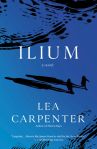
I enjoyed Ilium by Lea Carpenter, in which an unnamed young woman, looking for adventure, falls in love with, Marcus, a sophisticated older man. Just when everything is going well, he asks her for a “favor.” Marcus turns out to be a spy, involved in a CIA/Mossad plot called Operation Ilium. Our narrator agrees to help; she becomes the unlikely art advisor to a wealthy Russian family on Cap Ferrat. Various unreliable players ratchet up the suspense as our narrator tries to find the moral center.

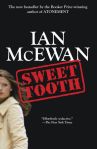
And lastly, there’s Ian McEwan’s Sweet Tooth, set during the Cold War, about a young woman recruited by MI5 to encourage writers with the right sort of politics to keep writing. Some reviewers took it seriously as a spy novel, some thought it was a spoof of spy novels. I thought it was lightweight McEwan, moderately entertaining, a good book for the summer.

l

The Voyage Home by Pat Barker

Pat Barker’s novel, The Voyage Home is the third volume in a trilogy called The Women of Troy, a retelling of the Trojan War that foregrounds the women’s experiences.  When this book opens, the Trojan War is just over after ten long years; the Greeks have sacked Troy and reveled in their victory by murdering the population in horrific ways. (Greek literature is not for the faint of heart.) Now the proud conquerors, they’re sailing home.

Agamemnon, the commander-in-chief, sets sail for his kingdom, Mycenae. With him is the young Trojan priestess Cassandra and her slave Ritsa, part of Agamemnon’s spoils of war. Cassandra is a fascinating and tragic character in Greek myth: she was kissed by the god Apollo, who gave her the ability to tell the future. When she refused to sleep with him, he cursed her, saying that no one would ever believe her prophecies. She becomes an outcast, even in her own family, the weird sister, spouting madness.  Agamemnon rapes her and carries her off. She is no longer Trojan royalty, she is in a strange limbo between concubine and slave.

We know the story of faithful Penelope, Odysseus’ wife, who waited twenty years for him to return home, meanwhile fending off dozens of suitors. This is not a repeat of that story. Agamemnon returns to Clytemnestra, a wife who despises him. Ten years earlier, he had sacrificed their daughter Iphigenia to the gods when the Greeks needed a favorable wind to sail for Troy. Clytemnestra has arranged a welcome that’s dark and bloody. For ten years, she’s been stoking the flames of her hatred. In Greek mythology and literature, Clytemnestra is the archetypal bad wife. Pat Barker has other ideas.

Cassandra and her slave Ritsa are thrown into the center of this minefield of a family reunion, and although Cassandra knows what will happen, there’s tension in the thought that she can change her fate.  Ritsa, her slave, is the main narrator, although some chapters are written from the point of view of Cassandra or Clytemnestra. You may know the story of Agamemnon and his forebears from Aeschylus’ plays, or from reading Homer and Greek mythology; those accounts are written from the male point of view. In The Voyage Home, the story is told by the women and takes on an emotional weight missing from the classic accounts. Barker uses all the elements of the myth but transmutes them into something very different. I found it riveting. 

I love retellings of Greek and Roman mythology, especially when the author uses the basic elements to flesh out the characters in a way that makes them walk off the page. Years ago, I read several of Mary Renault’s books about Theseus: The King Must Die and The Bull From the Sea. Those novels were so wonderful that I’ve read many more mythological and historical retellings. It’s pretty easy to find poorly written novels in this genre, so I’ve added a list of some of my favorites below.

The Silence of the Girls by Pat Barker (the first novel in the trilogy Women of Troy)

The Women of Troy by Pat Barker (the second novel in the trilogy Women of Troy)

The Song of Achilles by Madeline Miller (one of my all-time favorite books)

Circe by Madeline Miller

Imperium by Robert Harris (the first novel in the excellent trilogy about Cicero, the Roman statesman)

The Penelopiad: The Myth of Penelope and Odysseus by Margaret Atwood

Pandora’s Jar: Women in the Greek Myths by Natalie Haynes

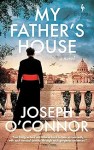
My Father’s House and Ghosts of Rome by Joseph O’Connor

I’ve read lots of mysteries and thrillers about people caught up in World War II, so when I had the opportunity to read The Ghosts of Rome by Joseph O’Connor before it was published (thank you, Europa Editions!) I jumped at the chance. I read and enjoyed it, but Ghosts of Rome is the second in a trilogy, so I felt I was missing out on something. Were the characters first introduced in the previous book, My Father’s House? I needed to know. 

I’m glad I went back to My Father’s House. That’s where I met Father Hugh O’Flaherty and the other members of the “Choir” that he assembled to help Allied soldiers, Jews, and prisoners of war escape from the Germans. (In 1943, Italy surrendered to the Allies and the Germans moved in and occupied northern Italy, including Rome.) My Father’s House takes place in Rome from Christmas Eve to Christmas Day, 1943. The Choir plans to carry out a mission, a rendimento, to distribute money to the escapees they have hidden. Complex plans, coded messages, and help from the Fascist Resistance ratchet up the tension in a story based on historical figures. 

There are eight members of the Choir, all from different backgrounds and religious persuasions, connected by the intensity of their hatred for the Nazis who capture, torture, and kill with callous impunity. Vatican City is neutral territory, a safe harbor, but also a prison: the inhabitants can only leave with permission from Paul Hauptmann, the vicious commandant of occupied Rome, who is under pressure from Himmler to shut down the escape line. The fugitives have all been secreted in Vatican City in various underground crypts and tunnels. The Choir calls them “books” and their locations are “shelves.” 

The high-stakes cat-and-mouse game between O’Flaherty and Hauptmann makes this a page-turner. O’Connor intensifies the reader’s involvement through character development of all the Choir members. The writing has vivid phrasing and descriptions, especially of the bitter, icy weather. You’ll need a warm scarf and a cup of hot tea to read this one. 

Ghosts of Rome continues the story of O’Flaherty and the Choir, who, despite harassment from Hauptmann won’t give up their rescue missions. Because he has failed to stop the Choir, Himmler moves Hauptmann’s wife and children to Berlin as hostages. In this second part of the trilogy, Contessa Giovanna Landini takes the lead role in planning and executing the missions. The Countess, elegant and charismatic, is relentless in her efforts. Finding safe places for the “books” becomes more difficult and the escapees are restless, hungry, bored, and not always cooperative. The situation is complicated by the discovery of a downed airman, a member of the Polish Resistance, badly injured. He becomes a liability that tests their resolve and resources, one of many moral and logistical problems that the Choir wrestles with. 

As in the first book, O’Connor intersperses chapters with memories of the Choir members recorded some years later, which flesh out their characters and fill in the details of the missions. They become real to the reader and as we learn more of their own troubled histories, we’re invested in their survival. A young English girl named Blon, full of fire and determination, becomes crucial to the survival of the wounded airman, but she’s also a loose cannon, disobeying the Choir protocols and taking frightening risks. Dark, literary, and full of tension, Ghosts of Rome is a welcome addition to the canon of resistance thrillers. I’m  looking forward to part three of the Rome Escape Line trilogy. 

Other books about Italy in World War II that I’ve enjoyed: 

A House in the Mountains: The Women Who Liberated Italy From Fascism by Caroline Moorehead. HarperCollins, 2021 nonfiction. (I’ve read several books by Caroline Moorehead and enjoyed them all.) 

Alibi by Joseph Kanon. Picador, 2006.  (fiction)

A Thread of Grace by Mary Doria Russell. Random House, 2005. (fiction)

Bread and Wine Ignazio Silone. reprint. Penguin, 2005. Silone’s classic novel about resistance to Fascism is beautifully written. I read it in high school and still remember it. 

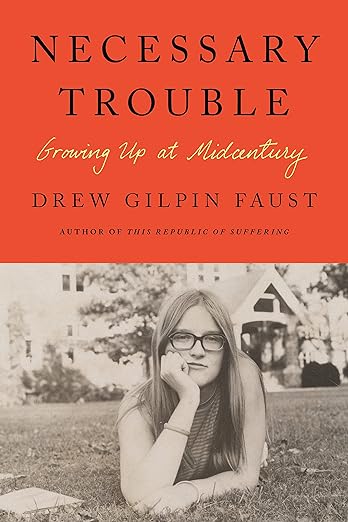
Necessary Trouble by Drew Gilpin Faust

Necessary Trouble

You may recognize the title of this book as part of a quote from the incomparable Civil Rights activist John Lewis. The phrase refers to the important work of upending racial discrimination. Lewis practiced raising “necessary trouble” all his life. He was an active force in the Civil Rights movement beginning in the 1960s and served in Congress from 1965 to his death in 2020.

“Thank you for getting into trouble, necessary trouble” is one of the epigraphs in Drew Gilpin Faust’s new memoir Necessary Trouble: Growing Up at Midcentury. It was Lewis’s comment to her on reading Faust’s memoir. She, too, participated in the Civil Rights movement and spent her adult life probing the events of the Civil War and its aftermath. She grew up in the horse country of northern Virginia in the 1950s, a rebellious daughter who disdained the Southern Belle upbringing her mother wanted for her. She was much more attracted to the free and independent life her brothers were allowed. But, “it’s a man’s world,” her mother always told her, “and you’d better get used to it.” She fought with her mother all her life over what was appropriate behavior. She writes that “…we never settled the larger part of the argument that was what we had instead of a relationship.” Necessary Trouble is a coming-of-age memoir from a time (the 1960s) when coming to maturity meant abandoning the mores and strictures of our mother’s lives and plunging headlong into another world.

At the age of nine, she wrote to President Eisenhower asking him to address the issue of equal rights for African-Americans. From an early age she disliked the inequality she saw growing up. A photocopy of her letter is on the opening pages of the book. She was lucky to attend schools that encouraged women and gave them the freedom to follow their interests and their passions.

During her college years at Bryn Mawr she spent the Freedom Summer of 1964 traveling in the South with other students; she skipped midterms to protest the Vietnam War; and she became a historian of the Civil War to understand the origins of U.S. racial justice issues. Faust and I are almost the same age so I enjoyed the chapters on the social history of the 1960s. They were such turbulent times! Her succinct and evocative description of what it was like to live through those times brought it all back for me. Faust brings her memoir up to the year 1968. There’s certainly more than enough to enjoy and think about in what she’s written but I suspect that at some point she’ll take us further. She was, after all, the first woman president of Harvard, from 2008 to 2018 and the author of several acclaimed books on the Civil War, including the outstanding This Republic of Suffering: Death and the American Civil War.

Several months ago I had the pleasure of hearing Faust speak about her life and her memoir to a full house at the incomparable Labyrinth Books in Princeton. She was interviewed by former Princeton president Shirley Tilghman, another brilliant, formidable woman. The room was full and there was a wonderful sense of ease between them, these women who had accomplished so much. There was no posturing, just a genuine sense that there was so much to be done and they were so glad that they had had a part in it.


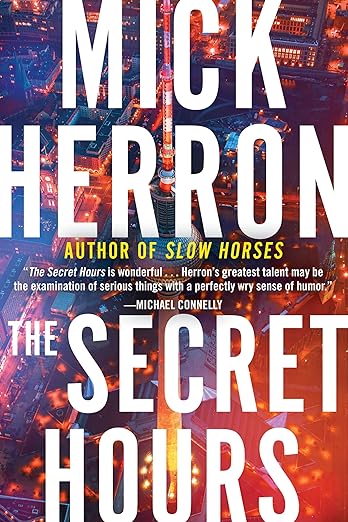
The Secret Hours by Mick Herron

Secret HoursI’m a big fan of the Slough House series and have read or listened to them all with great delight. Mick Herron’s plots about MI5 agents are satisfactorily convoluted and the characters are well distinguished from one another by their quirky–sometimes loathsome–personalities and politics. His new book, The Secret Hours, a standalone MI5 thriller, is related in plot and character to the Slough House books and filled with the same cloak-and-dagger intrigues, betrayals, and clever writing. Some of the current Slough House characters show up in earlier time periods so we finally learn their backstories although since they all change names as they move through their careers, Herron keeps readers guessing. The writing, as always, is witty and hilarious. Here’s an example, a description of the participants attending an oversight committee meeting:

“One or two were capable of independent thought, but when the whip came down, none would throw themselves in front of a foregone conclusion. All over Whitehall, the matchstick remains of once promising careers warned of the consequences of doing that.”

The book opens with the botched abduction of Max, a sixty-something former spook who’s been hiding in plain sight in a remote village in Devonshire since the nineties. The plot travels back and forth between today and 1994 to unravel the reason for his abduction, with Herron’s usual inter-office intrigue and backstabbing. Like the Slough House series, the main characters–Griselda and Kyle–are stuck in a backwater doing pointless, repetitive work until they stumble on the juicy nugget of Max’s history. Who sent them this file and why? Griselda and Kyle know they are putting their admittedly second-rate careers in jeopardy, but they long to do something that will put a sharp stick in the eye of the superiors who exiled them to the meaningless project Monochrome.

Flashbacks to Max’s spy days in Berlin reveal the earlier history of Jackson Lamb, the character that Slough House fans love to hate. (He’s brilliantly played by Gary Oldman in the Apple TV series). David Cartwright, grandfather of River Cartwright–everyone’s real favorite character–also plays a role. You don’t need to have read the other Slough House books to enjoy this one, but if Herron’s special brand of the cerebral and ribald appeals to you in this book, the Slough House series awaits.