Tag Archives: book-reviews

Reading lately…fiction

Here are three very different novels–maybe something for everyone? 
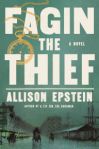
Fagin the Thief by Allison Epstein. I never read Oliver Twist, so I only knew that Fagin was a criminal mastermind, a trainer and taskmaster of thieving children, an anti-Semitic character written by a racist author. So I opened the book, determined that if it didn’t grab me right at the beginning, I’d put it aside. I enjoyed it and I’m glad I read it, but it has completely satisfied my interest in Oliver Twist. (I’m not a big Dickens fan.) Books that are riffs on characters in novels are hard to pull off, but great fun to read when they are successful. Kudos to Allison Epstein for this one; it’s an absorbing tale with lots of atmosphere.
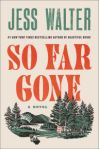
So Far Gone by Jess Walter. This was such fun to read, packed with humor, great characters, and a crackling story about love and loss. Crusty old Rhys Kinnick lives off the grid, preferring his own company to the craziness of the outside world. One day, without warning, his two pre-teen grandchildren show up at his door and the world crashes in on him once more. Their mother– estranged from Rhys since he sucker-punched her husband at Thanksgiving dinner–has gone AWOL and wants Rhys to take charge of the children. Garrulous nine-year-old Asher believes he’s a chess prodigy; Leah is a perceptive, wise-cracking twelve-year-old, an expert at eye-rolling. To avoid their angry father and his right-wing associates, the three take to the road, but here I must stop and let you have the pleasure of reading on. I read Walters’ first novel, Beautiful Ruins and loved it. His books are catnip for fans of Carl Hiaasen’s novels and the novel Norwegian By Night by Sheldon Horowitz. It also reminded me of the movie Oh Brother, Where Art Thou? in the best possible way. 
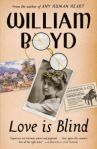
Love is Blind by William Boyd. Boyd is one of the great prose stylists of contemporary British literature. That doesn’t mean that his novels are stuffy, it just means he tells a great, beautifully written story. Years ago, I read his earlier novel, Any Human Heart and loved it; I’ve been waiting for another opportunity to read more of his writing. This new novel is a rich, absorbing tale, set in fin-de-siècle Europe. The main character is Brodie Moncur, a young Scottish piano tuner, talented enough to be just the least bit arrogant. He lands his first job, tuning pianos in Edinburgh, through a favor, moves on to Paris and impresses a piano virtuoso who hires him as his personal piano tuner. When he falls in love with the virtuoso’s lover, Lika, a beautiful seductive singer, his life becomes complicated. Their forbidden passion is more dangerous than Brodie realizes and it sets his life on a different course. 
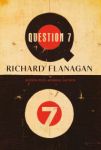
Question 7 by Richard Flanagan

It’s hard to know where to begin describing this book. It’s a memoir, but a memoir unlike any other I’ve read recently. Flanagan’s Question 7 interweaves stories and incidents from his life with descriptions of some of the most destructive episodes in human history, including the bombing of Hiroshima, the Holocaust, and the eradication of the native population in  Tasmania. Like the chain reactions in an atomic bomb, Flanagan builds to a moving, haunted climax by building his narrative around these events of ruin and loss.

Flanagan opens the memoir by describing his trip to the site of a World War II camp in Japan where his father had been interned as a slave laborer in a coal mine. Guides at the camp deny the existence of slave labor there. Flanagan writes, “Sometimes I wonder why we keep returning to beginnings–why we seek the single thread we might pull to unravel the tapestry we call our life in the hope that behind it we will find the truth of why. But there is no truth, there is only why.” His father’s experience has been erased; it’s one of several lessons in the power and fragility of memory.

In exploring the “why” of memory, Flanagan ranges over various subjects, starting with H.G. Wells’ prescient novel The World Set Free, written in 1913, in which Wells predicted the creation of a weapon of more destructive power than any previously known. Flanagan links Wells’ novel to the scientist Leo Szilard, who helped create the atomic bomb, but then, terrified by what he had done, tried to stop its use in Hiroshima. Chapters about Wells, Szilard, and other scientists and writers (including Vonnegut) circle around sections devoted to Flanagan’s childhood. The last chapter is the harrowing story of his almost-fatal kayak journey down the Franklin River in Tasmania when he was twenty-two. The trauma of that near-death experience–which is foreshadowed from the beginning–informs the entire book and connects to the story about his father’s experience in the slave labor camp. Time, memory, destruction, and literature are all woven together. I also now have a deeper appreciation of the way colonial history is embedded in the DNA of Australians and Tasmanians. Living “down under,” with its unique and savage history, ethnography, and geography, has had profound psychological ramifications.

Kirkus Reviews called Question 7 “a haunting, jagged, sparkling narrative puzzle in which the pieces deliberately refuse to fit.” That’s a great description of this ruminative, absorbing, and unsettling memoir. Flanagan leaves us with lots to think about.

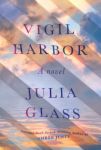
Vigil Harbor by Julia Glass

I’ve read most of Julia Glass’s novels because I love the way she develops characters. The plots are often slightly improbable, but the characters bring it off. Somehow, I missed Vigil Harbor when it came out in 2022 and recently found a used copy at my local bookstore. I was absorbed in it almost immediately. The book is set in the near future, with all the attendant issues of our warming planet.

Vigil Harbor is a town on Boston’s North Shore, an old fishing village that evolved into a wealthy enclave with a mainly white population. The residents feel lucky to live there, even though floods, severe storms, and high sea levels threaten the shore and wetlands, as they do everywhere on the coasts. People adapt as best they can. There are also threats from eco-terrorists, and that becomes an important part of the story.

When the novel opens, several marriages in the town have fractured and several families have suffered other kinds of losses. Austin, a local architect, hopes that the divorces will mean more work for him to build and renovate houses. His stepson, Brecht, home from college after a traumatic incident in New York, is trying to recover his equilibrium. Brecht is working for Celestino, the local landscaper, one of the few working-class people who live in town. A stranger arrives who knew Celestino years ago, someone who stirs up dangerous memories. Celestino is frightened as he watches Ernesto ingratiate himself with all the women. Another new arrival in town is Petra, posing as a journalist. She contacts Austin about writing a biography but her real motive is revenge for his abandonment of a former lover. In a lovely, fantastical touch, the mermaid Issa takes human form to warn the world about damage to the ocean. Her innocence is a heartbreaking contrast to the rest of the characters, who are anxious and uneasy in a world of ongoing catastrophes. Each chapter is told from the point of view of a different person, their stories gradually interlocking until the explosive ending.

What I love about Julia Glass’s novels is her generous spirit towards her characters, the way she gives them back stories and fully formed lives, inviting us to share their dreams and fears. There’s real life on the page, and that’s what I look for in a novel.

Now that I’ve checked my Goodreads list, I can see that I’ve read all her novels–I guess I’m a fan. If you haven’t read any of her novels, I’d recommend starting with Three Junes.

Three Junes

The Whole World Over 

I See You Everywhere

The Widower’s Tale

And the Dark Sacred Night

A House Among the Trees

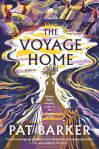
The Voyage Home by Pat Barker

Pat Barker’s novel, The Voyage Home is the third volume in a trilogy called The Women of Troy, a retelling of the Trojan War that foregrounds the women’s experiences.  When this book opens, the Trojan War is just over after ten long years; the Greeks have sacked Troy and reveled in their victory by murdering the population in horrific ways. (Greek literature is not for the faint of heart.) Now the proud conquerors, they’re sailing home.

Agamemnon, the commander-in-chief, sets sail for his kingdom, Mycenae. With him is the young Trojan priestess Cassandra and her slave Ritsa, part of Agamemnon’s spoils of war. Cassandra is a fascinating and tragic character in Greek myth: she was kissed by the god Apollo, who gave her the ability to tell the future. When she refused to sleep with him, he cursed her, saying that no one would ever believe her prophecies. She becomes an outcast, even in her own family, the weird sister, spouting madness.  Agamemnon rapes her and carries her off. She is no longer Trojan royalty, she is in a strange limbo between concubine and slave.

We know the story of faithful Penelope, Odysseus’ wife, who waited twenty years for him to return home, meanwhile fending off dozens of suitors. This is not a repeat of that story. Agamemnon returns to Clytemnestra, a wife who despises him. Ten years earlier, he had sacrificed their daughter Iphigenia to the gods when the Greeks needed a favorable wind to sail for Troy. Clytemnestra has arranged a welcome that’s dark and bloody. For ten years, she’s been stoking the flames of her hatred. In Greek mythology and literature, Clytemnestra is the archetypal bad wife. Pat Barker has other ideas.

Cassandra and her slave Ritsa are thrown into the center of this minefield of a family reunion, and although Cassandra knows what will happen, there’s tension in the thought that she can change her fate.  Ritsa, her slave, is the main narrator, although some chapters are written from the point of view of Cassandra or Clytemnestra. You may know the story of Agamemnon and his forebears from Aeschylus’ plays, or from reading Homer and Greek mythology; those accounts are written from the male point of view. In The Voyage Home, the story is told by the women and takes on an emotional weight missing from the classic accounts. Barker uses all the elements of the myth but transmutes them into something very different. I found it riveting. 

I love retellings of Greek and Roman mythology, especially when the author uses the basic elements to flesh out the characters in a way that makes them walk off the page. Years ago, I read several of Mary Renault’s books about Theseus: The King Must Die and The Bull From the Sea. Those novels were so wonderful that I’ve read many more mythological and historical retellings. It’s pretty easy to find poorly written novels in this genre, so I’ve added a list of some of my favorites below.

The Silence of the Girls by Pat Barker (the first novel in the trilogy Women of Troy)

The Women of Troy by Pat Barker (the second novel in the trilogy Women of Troy)

The Song of Achilles by Madeline Miller (one of my all-time favorite books)

Circe by Madeline Miller

Imperium by Robert Harris (the first novel in the excellent trilogy about Cicero, the Roman statesman)

The Penelopiad: The Myth of Penelope and Odysseus by Margaret Atwood

Pandora’s Jar: Women in the Greek Myths by Natalie Haynes

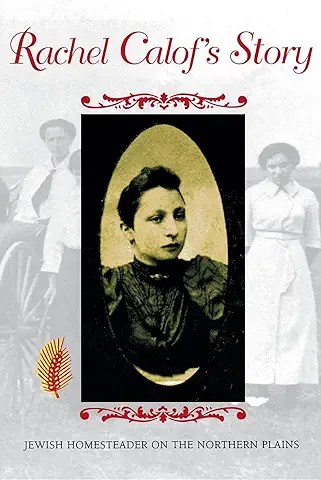
Rachel Calof’s Story

Rachel Calof's StoryLike many other immigrant groups, Jews took advantage of the US government program that helped settle parts of the Midwest and West by giving a portion of free land to people who agreed to farm it. That’s how Jews came to North Dakota, a frozen, hostile, windswept, and often heartbreaking place to be a pioneer. In 1894, a young Russian woman named Rachel Bella Kahn came to the US to marry, sight unseen, a young man named Abraham Calof, who was living with his family in northeastern North Dakota.

New Yorkers know about the role of the Lower East Side in Jewish life, often from family stories. Some of you may have been to the Tenement Museum which gives such a vivid sense of what life was like not just for our Jewish forebears, but for other immigrant groups as well. But there were Jews who didn’t stop in New York, who kept on going, and one of my favorite memoirs by a woman who traveled further west is Rachel Calof’s Story.

Rachel Bella Kahn was born in a shtetl (village) in Russia in 1874 and at the age of four, her mother died, leaving her the oldest daughter. By age eight, she was fully responsible for her two younger siblings. Her father eventually remarried, but it was not a good situation for Rachel and she was sent to another shtetl to live with relatives. As a dependent in another household, she knew she was in an awkward position, so when an immigrant gentleman in America sent a request to the village for a bride, it seemed like the right time for Rachel to move on. She undertook the arduous journey to New York, alone, and there she met Abraham Calof who had made the long train trip from his home in North Dakota to meet her.

Much to her delight, he seemed like a kindred spirit, and after a few weeks of acquaintance, they took the train west to North Dakota where his parents, two brothers, and two nieces had just settled with their families. Rachel is shocked by their unkempt appearance, their apparent ignorance; and her prospective mother-in-law’s unreasonable demands. They have all been living in 12×14 shacks in this desolate land, with the most primitive of furnishings and supplies. The prairies are barren and desolate; their only fuel for warmth in the frigid winters is dried cow dung. The night Rachel and Abraham arrive, they discover that their own shack has been blown upside-down by a windstorm and now has no roof. They must move in with her future in-laws. This is her introduction to a life of incredible travail and privation. In that day and age, of course, she is repeatedly pregnant, delivering her children on the wooden kitchen table, and nature, accidents of weather and fire, and errors of judgment take their toll. But Rachel is rarely daunted—she has an amazing ability to make the best of her situation.

How do we come to have this record? In 1936, Rachel Bella Kahn Calof purchased a writing tablet and began to reconstruct her life story. She probably wanted to pass the memoir down to her descendants. It certainly never occurred to her that you or I would be interested in her life. She probably didn’t give it the name “memoir.” According to her family, she rarely discussed her past and she never kept a diary. She wrote her story straight out in Yiddish with rarely a change of wording, as if it had been forming in her mind for years, just waiting until she had time to set it down. We are richer for having this narrative about one brave Jewish woman’s experience. As she writes at the end of her story: “I had traveled a long and often torturous way from the little shtetl in Russia where I was born. It wasn’t an easy road by any means, but if you love the living of life you must know the journey was well worth it.” It’s a remarkable and absorbing account. I’ve picked up this book over and over, happy to be in the company of such an extraordinary woman.

Calof, Rachel and J. Sanford Rikoon. Rachel Calof’s Story. Indiana Univ. Press, 1995.