
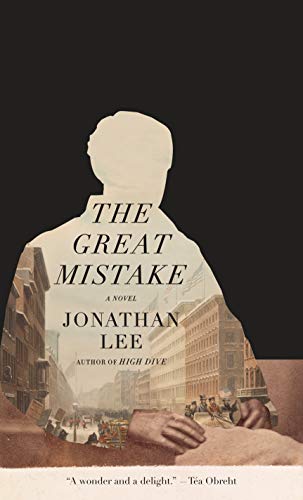
 I’m still mostly reading my daily LitHub email rather than books; life is still a little complicated here but I will get back to reading books soon. Here’s a link to an interesting interview with Jonathan Lee, about his new novel, The Great Mistake, about the historical character Andrew Haswell Green, who did as much as anyone to create the New York City we live in today.
Green’s fingerprints are on Central Park, Columbus Circle, Broadway’s boulevard-like appearance, and several of our most important museums. He also pushed for the 1898 consolidation of the five boroughs–what many people thought of as a great mistake, hence the title. At the age of 83, Green was murdered on the front steps of his house. His name and reputation descended rapidly into obscurity and he’s little known today.
What great material for a biographer or novelist! In the interview (reprinted from Interview Magazine), David Goodwillie asks Lee about the decision to fictionalize Green’s life. Lee gives an interesting answer: there were years in Green’s life where little or no historical information was available. Writing Green’s life as a novel gave him the opportunity to fill in those gaps. There’s also an interesting discussion between Green and Goodwillie about what makes fiction “literary.” Here’s what Lee says: the literary writer toils in…not the minutia, exactly, but the interior, the personal, the moments that may be just as life defining but from the outside might look small, even inconsequential.” I think that’s one aspect of literary fiction but not the whole enchilada.
I read and enjoyed Jonathan Lee’s last novel, High Dive, about the IRA’s assassination attempt on Margaret Thatcher at the Grand Hotel in Brighton, England in 1983. I’m guessing Lee is drawn to historical fiction that allows him to fill in the blanks. I’ll put his new one on my to-read list.
 There’s at least one other fictionalized version of the assassination attempt at the Brighton Hotel: Adrian McKinty’s mystery In the Morning I’ll Be Gone, part of his Sean Duffy series. I loved that series and hope McKinty will write at least one more!
 I subscribe to
  A friend loaned me this book with an enthusiastic recommendation. Although many people love, love, love John Irving, I’m not one of them. Years ago I read
  I read this short novel in one sitting, captured by the distinctive first person narration of the unnamed main character. She’s raising chickens, four multi-colored, empty-headed creatures that occupy a great deal of her time and thoughts. In the first few chapters, I had to keep reminding myself that
 I’ve always believed that appreciating good art in any medium requires our effort. Good art doesn’t come to us–we go to it. The more we extend ourselves to understand what the writer (or artist or composer) intends, the more we can learn from it and the more it will enrich our lives. Of course, that begs the question–what is good writing? How do we know what writing is worth our close attention? Not all writing is good and, of course, “good” is a subjective term. There were even times when Shakespeare was considered just a middling playwright. And maybe, for practical purposes, “good” writing is just what we enjoy whether it’s critically acclaimed or not.
 I found
  A few years ago I read Davies’ novel
  I’m sure you can tell that I’ve been reading more escapist novels than usual in this strange winter of our isolation. Southern noir certainly fills the bill.
 This mystery is #6 in a series featuring the retired New York police detective Dave Gurney. I haven’t read the earlier titles in the series but now that I’ve enjoyed this one so much, I’ll go back and try the others in order.
 A Reader's Place