
 I don’t think I’ve mentioned that I’ve practiced Buddhist meditation for several years. I started during a period of anxiety; I just couldn’t let go of all the things that might go wrong. A Mindfulness class helped and I began to attend Sunday morning meditation and dharma talks at the Community Meditation Center in Manhattan, which follows a Theravada practice. It did help with the anxiety, but more than that, I discovered that Buddhism sees the world in a way that feels comforting and relatable to me.
Those Sunday morning sessions introduced me to several inspiring teachers and their writings. I’ve also taken part in a few one-day meditation retreats. I keep a small collection of books by my favorite Buddhist teachers on my nightstand and re-read them often. They remind me how to face the world. I’ve listed them at the end of this post.
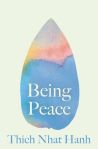
One of the most revered teachers of contemporary Buddhism is Thich Nhat Hanh, who died in 2022. I recently read a reprint of one of his books (he wrote many) called Being Peace. It’s been added to my nightstand collection. It’s wonderful.
Thich Nhat Hanh writes about how we can’t create a peaceful world unless we practice peacefulness and compassion in our own lives. “If we are not happy, if we are not peaceful, we can’t share peace and happiness with others, even those we love…because without being peace we cannot do anything for peace.” The balance of the book is about steps we can take to achieve peacefulness for ourselves. Meditation, of course, is an important step. Being aware of the present moment is another important practice. “We tend to postpone being alive to the future, the distant future, we don’t know when.” It’s often true that we are waiting for some event in the future–then we’ll be happy, peaceful.
In the opening section of the book, Thich Nhat Hanh explains three basic aspects of Buddhism: the Buddha, the dharma (the teachings of the Buddha), and the sangha (the community of Buddhists). His explanations of the meaning and importance of these three things is simple and elegant, a good introduction for non-Buddhists. In fact, everything about this little book is simple and elegant.
The books on my nightstand:
Olendzki, Andrew. Untangling Self: A Buddhist Investigation of Who We Really Are. Wisdom Publications, 2016.
Olendzki, Andrew. Unlimiting Mind: The Radically Experiential Psychology of Buddhism. Wisdom Publications, 2010.
Liebenson, Narayan Helen. The Magnanimous Heart: Compassion and Love, Loss and Grief, Joy and Liberation, Wisdom Publication, 2019.
 A Reader's Place