
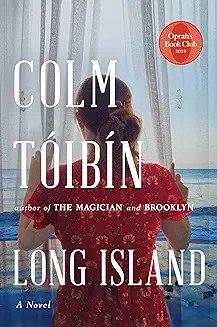
 You may have read Colm Toibin’s novel Brooklyn, when it came out in 2015 and enjoyed the character study of a young Irish girl in Brooklyn in the 1950s. Eilis Lacey is serious and intelligent and there’s nothing much for her in her hometown of Enniscorthy. Her mother, her beloved sister Rose, and the local priest arrange for her to move to Brooklyn. She leaves behind some unfinished business with a handsome young man and finds herself a shopgirl in a strange country. No one, least of all Eilis, anticipates that an Italian boy, Tony, will persuade her to marry and move to Long Island in the years of the rush to the suburbs. Tony and his brothers plan to catch the post-war construction boom and make a sweet life for everyone. Without her family, Eilis is unmoored and Tony’s affection carries her along. That’s a drive-by version of the story.
In Long Island we meet up with Eilis again, now in her forties, the mother of two teenagers. Her life is circumscribed by the family compound where she lives, next door to Tony’s two brothers, their wives and children, and her in-laws. Navigating the boisterous weekly family get-togethers is still a trial for the reserved Eilis and the family senses her discomfort. She is still the same private, thoughtful person we met in Brooklyn. When the novel opens, there’s a knock on the door with bad news: Tony will shortly be the father of another woman’s child, a child who will be deposited on Eilis’s doorstep when it is born. Eilis has no intention of raising this child. Tony’s family doesn’t feel the same way: the new baby must be accepted as a precious addition, despite Tony’s transgression. Angry and devastated, Eilis returns to Enniscorthy for the summer to avoid the late August date when the baby will be brought to her door, and to underscore her determination to have nothing to do with the infant. She’s not at all sure what the future holds for her. Maybe she won’t return to Long Island. What she finds when she returns to Enniscorthy is not at all what she expected.
Toibin works very slowly, with a plaintive and impatient Eilis discovering that some things in Enniscorthy have changed but most have not, especially for women. The same social mores exist as when she lived there. She can’t confide in anyone and expect to receive sympathetic support. As the days pass, her dilemma is complicated by the reawakened emotional ties with her old boyfriend, Jim. Toibin doesn’t let the reader completely into Eilis’s thoughts; it’s through her actions that we sense her hopes and plans. Like Brooklyn, there is a constant sense that Eilis can’t live her life on her own terms. No spoilers here and in fact, Toibin leaves us guessing about Eilis’s future. A sequel? I hope not; I’d rather imagine for myself what this strong-minded woman will do.
 A Reader's Place