
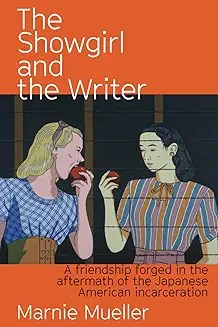
 On April 11th I’ll be interviewing author Marnie Mueller on Zoom at 7pm EDT. Marnie’s new book is a surprising story, a combined memoir and biography (maybe a new genre?) about her own life and a life-changing friendship. Here’s a link to register; it’s free.
I met Marnie a few years ago, and she kept me posted about the book she was working on. It always sounded fascinating, so when it was published, I bought a copy. The full title is The Showgirl and the Writer: A Friendship Forged in the Aftermath of the Japanese Incarceration (Peace Corps Writers Press). It’s a great story and I knew right away that I had to write about it for this blog and interview her as well. Sometimes a book deserves to be read by a wide audience. As you can tell from the subtitle, it’s not a novel, but a memoir plus a biography. Keep reading…
Marnie tells the remarkable true story of two women, one white (herself) and one Asian (Mary Mon Toy), who forged a deep friendship based on the secrets they carried. Marnie, a Caucasian, was born in a Japanese incarceration camp during World War II because her parents had moved there to help make life more tolerable for the internees. Later, when her family moved to New England, Marnie learned that it was not a good idea to say she was born at Tule Lake Japanese Incarceration Camp. Many people didn’t know about the camps and were confused, convinced this little girl was fantasizing. It wasn’t much better to admit that you were Jewish. After the War, rampant anti-Semitism marked her in another way as an outsider. What experiences defined Marnie? It was hard for her to know. After college, she spent two years as a Peace Corps volunteer in Ecuador; worked in New York City as a community organizer; spent time as a folk and rock concert promoter; and was the program director for WBAI. She married and did her best to move on despite a persistent feeling of loss and disorientation.
In 1994, Marnie attended a meeting of a Japanese-American cultural organization where she met Mary Mon Toy, who had a successful Broadway and nightclub career as a Chinese actress and singer. Mary was beautiful, ambitious, and determined. Their friendship, born of shared experiences, was life-changing for both women, a chance to learn about each other and maybe to heal. Marnie became Mary Mon Toy’s friend and caregiver in her last years but as much as she thought she knew, there were secrets Mary kept even from her. The last section of the book reveals those secrets and the research journey that led Marnie to uncover Mary Mon Toy’s real life as the survivor of a Japanese internment camp who “passed” as a Chinese woman to avoid discrimination.
You may not know much about the incarceration of the Japanese population on the West Coast during World War II. This shameful episode is not generally taught in American history classes. Maybe you read about it in Snow Falling on Cedars or Farewell to Manzanar. Concentration camps in the U.S.? Unthinkable but true. Join me on April 11th and learn more.
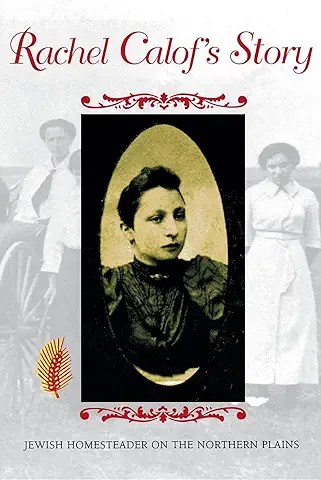 Like many other immigrant groups, Jews took advantage of the US government program that helped settle parts of the Midwest and West by giving a portion of free land to people who agreed to farm it. That’s how Jews came to North Dakota, a frozen, hostile, windswept, and often heartbreaking place to be a pioneer. In 1894, a young Russian woman named Rachel Bella Kahn came to the US to marry, sight unseen, a young man named Abraham Calof, who was living with his family in northeastern North Dakota.
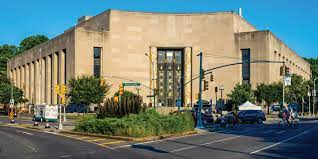 After I wrote that last blog post about Rita Dove’s poem for the Folger Shakespeare Library, I started thinking about the quote that I love on the main branch of the Brooklyn Public Library. Dove’s words about crafting a poem that would be inscribed on stone rather than read on the page made me see that BPL poem in a new light. It’s a perfect example of what she spoke about, how writing within constraints can produce something wonderful.
 A Reader's Place