Monthly Archives: February 2024

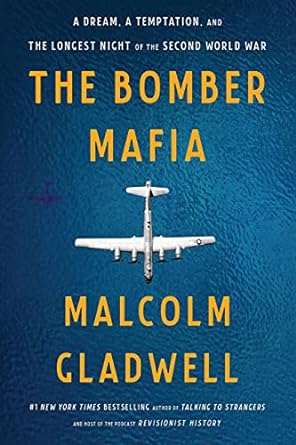
The Bomber Mafia by Malcolm Gladwell

Bomber Mafia

This is not my usual fare, although I do enjoy good war stories. A friend who’s doing research on the experiences of her father in World War II recommended it to me and I’m very happy she did. Gladwell tells the true story of a paradigmatic change in the U.S. Army Air Force before and during World War II. The Bomber Mafia was published first as an audiobook, complete with atmospheric music and sound effects, as well as clips of interviews with the main characters and military historians. Now it’s also available as a book, but I highly recommend the audio. It’s only about five hours and totally immersive. Gladwell is the narrator and does a sterling job.

The Air Force didn’t become a separate military service until 1947. During World War II it was part of the Army and called the Air Corps. In the 1930s, the military couldn’t figure out how airplanes were going to contribute to the next war; they saw them as support for ground troops. Maybe they’d need a few planes. However, a group of driven, idealistic, iconoclastic Air Corps pilots and officers had a vision that planes could take the place of ground troops by using high-altitude, daylight precision bombing. For their radical vision, they were known as the Bomber Mafia. They were brilliant, often eccentric officers; their personalities and disputes, plus Gladwell’s high-energy reading make it all very colorful and fun to listen to.

It was quite a stretch for the tradition-bound military services to accept this idea of high altitude, daylight bombing, but the Bomber Mafia persisted in trying to convince the generals. There was a new bombsight, invented by a Dutchman named Carl Norden, that had a high level of accuracy. It was a complicated analog computer that supposedly could put a bomb into a pickle barrel. If the Air Corps deployed this device, fewer pilots would be killed, fewer planes lost, and there would be fewer casualties on the ground. The Bomber Mafia thought the Norden bombsight was just the thing to win the coming war. The U.S. was the only country that had it. What could go wrong?

One of my uncles was a Seabee in the Navy, stationed on Tinian, part of the Mariana Islands in the Pacific that were used as bases to launch bombs against Japan. The Seabees built the airfields under enemy fire. There’s a family story about how his sister, my mother, sent him a jar of peanut butter. He turned up his nose and tossed it in the sand, but then crawled out to find it later when heavy shelling devastated their food supplies. After listening to The Bomber Mafia I now have a sense of what it must have been like for him. Haywood Hansell was the commander on Tinian, hoping to use the Norden bombsight for high altitude daylight bombing and validate the approach of the Bomber Mafia. He was sure Japan would surrender soon. It didn’t go so well for several interesting reasons, and he was replaced by Curtis LeMay, a traditionalist. LeMay had another approach that he was also sure was the right one.

I won’t tell any more of the details, except to say that Gladwell brings out the moral questions inherent in the story and the personalities of the principal protagonists (and antagonists). I’m pretty sure that if you start listening to this, you’ll be riveted to the end.

Folger Shakespeare Library podcasts

Rita DoveI’m thinking about going to Washington this spring to see the museum and a play at the Folger. I’ve always wanted to go–they have eighty-two First Folios!–and I think this will be the year. On other trips to D.C. I’ve concentrated on the art museums but it’s time to give the literary side of the city a go. In preparation, I’ve subscribed to the Folger newsletters and podcasts and last week I heard a podcast that was so wonderful that I had to pass it along to you. 
For the past several years, the Folger has been undergoing renovations, enlarging and reconfiguring their space. For their expanded garden they wanted a special poem that would appear on the marble berm that encircles the garden. Rita Dove was asked to write the poem. Dove was U.S. Poet Laureate for two terms from 1993-1995, the first African-American to receive that honor. It’s one of many honors she’s been given. She also tells a terrific story on the podcast about how she began to read and enjoy Shakespeare at an early age.

The podcast is wonderful because Dove talks about the difference between writing poetry for the page and writing for marble. She’s interviewed by Barbara Bogaev, who some of you may know as an occasional substitute for Terry Gross. I’ve always liked Bogaev–she has a lovely voice and is an excellent interviewer because she’s a warm and attentive listener. I was skeptical about how the topic could fill a podcast, but I was so wrong. Dove’s insights about how she thought about writing a poem for marble are a revelation. I will never look at an inscription on a building the same way again. And by the way, the poem, shown below, is wonderful; the imagery is just perfect for a garden. Here’s the link to the podcast.

Welcome Poem by Rita Dove for the Folger Shakespeare Library garden

Clear your calendars. Pocket your notes.

Look up into the blue amplitudes,

sun lolling on his throne, watching clouds

scrawl past, content with going nowhere.

No chart can calibrate the hush that settles

just before the first cricket song rises;

no list will recall a garden’s embroidery,

its fringed pinks and reds, its humble hedges.

Every day is Too Much or Never Enough,

so stop fretting your worth and berating

the cosmos – step into a house where

the jumbled perfumes of our human potpourri

waft up from a single page.

You can feel the world stop, lean in, and listen

as your heart starts up again.

                                          –Rita Dove

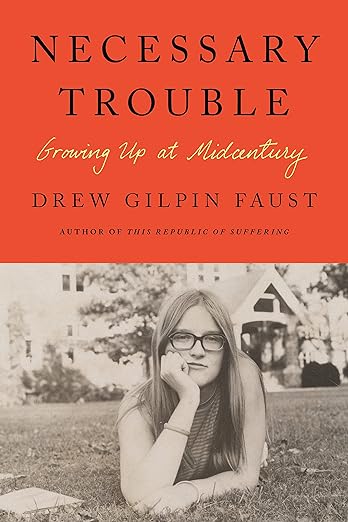
Necessary Trouble by Drew Gilpin Faust

Necessary Trouble

You may recognize the title of this book as part of a quote from the incomparable Civil Rights activist John Lewis. The phrase refers to the important work of upending racial discrimination. Lewis practiced raising “necessary trouble” all his life. He was an active force in the Civil Rights movement beginning in the 1960s and served in Congress from 1965 to his death in 2020.

“Thank you for getting into trouble, necessary trouble” is one of the epigraphs in Drew Gilpin Faust’s new memoir Necessary Trouble: Growing Up at Midcentury. It was Lewis’s comment to her on reading Faust’s memoir. She, too, participated in the Civil Rights movement and spent her adult life probing the events of the Civil War and its aftermath. She grew up in the horse country of northern Virginia in the 1950s, a rebellious daughter who disdained the Southern Belle upbringing her mother wanted for her. She was much more attracted to the free and independent life her brothers were allowed. But, “it’s a man’s world,” her mother always told her, “and you’d better get used to it.” She fought with her mother all her life over what was appropriate behavior. She writes that “…we never settled the larger part of the argument that was what we had instead of a relationship.” Necessary Trouble is a coming-of-age memoir from a time (the 1960s) when coming to maturity meant abandoning the mores and strictures of our mother’s lives and plunging headlong into another world.

At the age of nine, she wrote to President Eisenhower asking him to address the issue of equal rights for African-Americans. From an early age she disliked the inequality she saw growing up. A photocopy of her letter is on the opening pages of the book. She was lucky to attend schools that encouraged women and gave them the freedom to follow their interests and their passions.

During her college years at Bryn Mawr she spent the Freedom Summer of 1964 traveling in the South with other students; she skipped midterms to protest the Vietnam War; and she became a historian of the Civil War to understand the origins of U.S. racial justice issues. Faust and I are almost the same age so I enjoyed the chapters on the social history of the 1960s. They were such turbulent times! Her succinct and evocative description of what it was like to live through those times brought it all back for me. Faust brings her memoir up to the year 1968. There’s certainly more than enough to enjoy and think about in what she’s written but I suspect that at some point she’ll take us further. She was, after all, the first woman president of Harvard, from 2008 to 2018 and the author of several acclaimed books on the Civil War, including the outstanding This Republic of Suffering: Death and the American Civil War.

Several months ago I had the pleasure of hearing Faust speak about her life and her memoir to a full house at the incomparable Labyrinth Books in Princeton. She was interviewed by former Princeton president Shirley Tilghman, another brilliant, formidable woman. The room was full and there was a wonderful sense of ease between them, these women who had accomplished so much. There was no posturing, just a genuine sense that there was so much to be done and they were so glad that they had had a part in it.


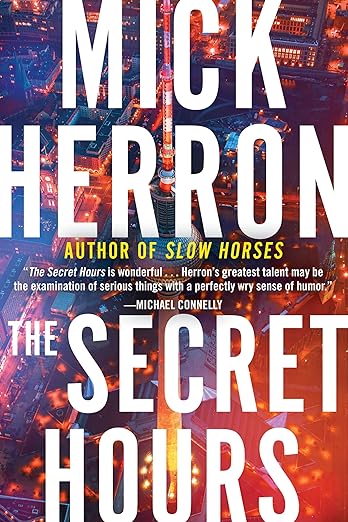
The Secret Hours by Mick Herron

Secret HoursI’m a big fan of the Slough House series and have read or listened to them all with great delight. Mick Herron’s plots about MI5 agents are satisfactorily convoluted and the characters are well distinguished from one another by their quirky–sometimes loathsome–personalities and politics. His new book, The Secret Hours, a standalone MI5 thriller, is related in plot and character to the Slough House books and filled with the same cloak-and-dagger intrigues, betrayals, and clever writing. Some of the current Slough House characters show up in earlier time periods so we finally learn their backstories although since they all change names as they move through their careers, Herron keeps readers guessing. The writing, as always, is witty and hilarious. Here’s an example, a description of the participants attending an oversight committee meeting:

“One or two were capable of independent thought, but when the whip came down, none would throw themselves in front of a foregone conclusion. All over Whitehall, the matchstick remains of once promising careers warned of the consequences of doing that.”

The book opens with the botched abduction of Max, a sixty-something former spook who’s been hiding in plain sight in a remote village in Devonshire since the nineties. The plot travels back and forth between today and 1994 to unravel the reason for his abduction, with Herron’s usual inter-office intrigue and backstabbing. Like the Slough House series, the main characters–Griselda and Kyle–are stuck in a backwater doing pointless, repetitive work until they stumble on the juicy nugget of Max’s history. Who sent them this file and why? Griselda and Kyle know they are putting their admittedly second-rate careers in jeopardy, but they long to do something that will put a sharp stick in the eye of the superiors who exiled them to the meaningless project Monochrome.

Flashbacks to Max’s spy days in Berlin reveal the earlier history of Jackson Lamb, the character that Slough House fans love to hate. (He’s brilliantly played by Gary Oldman in the Apple TV series). David Cartwright, grandfather of River Cartwright–everyone’s real favorite character–also plays a role. You don’t need to have read the other Slough House books to enjoy this one, but if Herron’s special brand of the cerebral and ribald appeals to you in this book, the Slough House series awaits.