
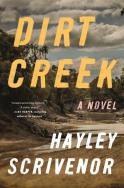
 I’m sure you’ve all read–or read reviews of–those novels where a young girl goes missing. It’s become a sub-genre of domestic fiction and coming-of-age novels. When I read a good review of such a book I sigh. Do I have to read this one? Well, yes, I did have to read the brand-new Dirt Creek because it’s set in Australia. For me, Australian noir has replaced Scandinavian noir. Trust me on this. It’s a long way from the bitter cold and long nights of Nordic mysteries to the sun-parched, drought-ridden, cheerless towns of the outback, but it’s a trip you need to take. I’ve appended, at the bottom of this post, a few other titles I’ve enjoyed in recent years. I’ve been to Australia and it seemed like a cheery place, full of those funny greetings (G’day mate!) and strange animals, but hey, what does a tourist know about the dark corners?
There are the familiar tropes in Dirt Creek: a popular twelve-year-old girl goes missing; her friends and their families have secrets they keep from the authorities; a policewoman with her own issues is sent from the big city to solve the crime. Scrivenor’s success with these familiar plot devices comes from the characters she creates and the narrative structure. Esther, the girl who goes missing, is more than just a good friend to Ronnie and Lewis, outsiders in their school. She’s the one who makes them feel safe and understood. Their parents and extended families are a mess. Their town, called Durton–dubbed “Dirt Town” by the teens–lives up to its name.
Each chapter focuses on a different character, building a picture of the town along with relationships and motivations. One of the characters speaks in the first person and there are chapters in the third person as well, kind of a chorus of the town’s children, whose voices reflect, look back, and create tension. Here’s an example from one of the third-person sections: “We understood, even then, that bad things happened. And we understood that sometimes people made them happen, sometimes those people were close to us, or even ourselves.”
But more than that, Scrivenor locates emotions in the bodies of her characters, describing exactly how events made them feel: the stone lodged in the stomach, the sensation of choking, the claustrophobia in the lungs. We know that Esther won’t come back, but it’s the way each person is bound up in the story that makes it so compelling.
Other Australian noir that I’ve read and enjoyed:
The Dry by Jane Harper. Flatiron Books, 2017. (now a movie) This was the first book in the detective Aaron Falk series.
Force of Nature by Jane Harper. Flatiron Books, 2018. Second book in the Aaron Falk series. (The third in the series, Exiles, is coming out in January, 2023.)
Scrublands by Chris Hammer. Atria Books, 2019.
Breath by Tim Winton. Farrar, Straus, and Giroux, 2008.
Paperbark Shoe by Goldie Goldblum. Picador, 2011.
 In pre-pandemic times, I used to meet occasionally in the evenings with several women at the cafe French Roast in Greenwich Village. A glass (or two) of wine, maybe a salad or tartine, and good conversation. It’s not so easy these days to meet people in a casual way and I miss those gatherings. One of the women at those French Roast gatherings was Fatima Shaik, the author of
  A Reader's Place