
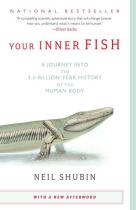
 I’ve always wondered just how fish developed into land creatures, or, put another way, how humans developed from fish. Yes, I know it took millions of years, but what were the intermediate steps? That’s the subject of Your Inner Fish. Paleontologist Neil Shubin takes a fascinating, complex subject and makes it accessible to non-science folks, like me. By studying the fossil record, embryonic development, and DNA, scientists have developed a model of how this could have happened. To cut to the chase, the basic structural features of embryos are similar; it’s the messages encoded in our DNA that make the difference in what we become. Your Inner Fish is one of those books that will change the way you look at fish, amphibians, and mammals (including humans). A trip to the zoo will be a different experience: you’ll see animals in a new way, more like us.
Early in his career, Shubin started looking for fossils of fish. With very little funding, he first worked with a group of scientists in Pennsylvania in places where roads had been cut through mountains, exposing layers of rock. No glamour there, but he was hooked. The fossils he found showed how fish developed the features that allowed them to survive on land. Take, for instance, necks! A neck is not so important if you’re living in the water, where you can easily swivel your entire body about, but on land, the ability to turn your head is crucial to survival. Shubin found fossils with various stages of neck development. Over the course of many expeditions, he uncovered fossils that were in intermediate stages of development for other parts of our bodies. Shubin’s enthusiasm and persistence and his stories of working collaboratively with colleagues are delightful and very enlightening.
 The title of Jonathan Franzen’s latest novel is very apt–all the characters are at crossroads in their lives and every chapter ends with another messy situation so the reader is repeatedly reminded of the title. In some cases, a character is literally at a crossing in the road at the end of a chapter. The story is told by five members of the Hildebrandt family, and it’s set in the early 1970s in a suburb of Chicago.
 A Reader's Place