Monthly Archives: October 2020

Chasing Chopin by Annik LaFarge

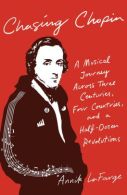
Chasing ChopinAt the moment I’m listening to Chopin’s Etude Op. 25 No. 10, called “The Winter Wind” for the way it evokes the howling wind of a winter storm.  I’ve listened to Chopin for many hours in the past three days, since I finished reading Chasing Chopin: A Musical Journey Across Three Centuries, Four Countries, and a Half-Dozen Revolutions by Annik LaFarge.

This wonderful short book is a love letter to Chopin. It’s not a biography, although you will learn about the composer’s life and relationship with his longtime lover, the novelist George Sand, nom de plume of Amantine Lucile Aurore Dupin. It’s also not a book of musical criticism, nor is it a treatise about the difficulties of playing Chopin’s music. LaFarge starts by recounting a visit to a friend who was dying. The next piece of music she heard, at a jazz club, quoted Chopin’s “Funeral March” and she was jolted by the coincidence. The “Funeral March” becomes the thread that ties the various parts of the story together. (Although a number of Chopin’s pieces have programmatic names, Chopin himself hated this practice; all the names were supplied by others.)

LaFarge visits all the places where Chopin lived to recapture the atmosphere and history he might have experienced. One of the most moving sections of the book is set on Majorca, where Sand and Chopin lived for a while in 1838-9. Chopin was in Paris, very ill, coughing up blood and Sand wanted to find a place of warmth and light where he could regain his strength. The trip was not altogether a success: the weather in Majorca was cold and rainy and it took almost six months for Chopin’s piano to arrive. He had ordered a Pleyel pianino to be shipped to Majorca and it was held up by bad weather and extortionate customs fees. Chopin, Sand, and Sand’s two children ended up living in Valldemossa, in the hills northwest of Palma in a abandoned medieval monastery. The locals didn’t welcome this unusual couple–one with tuberculosis, the other a strange genre-bending woman. The sun and warmth they initially encountered quickly turned to cold and rain. It was not the most salubrious place for Chopin, but he wrote some of his most beautiful pieces there.

LaFarge visited the monastery, now a Chopin museum, which contains the Pleyel pianino and some of Chopin’s handwritten manuscripts. Many other music lovers and pianists have made the trek but maybe none so devoted as Nobuyuki Tsujii, a brilliant blind pianist, who stayed overnight on a cot in the room next to Chopin’s studio. LaFarge has a companion website, www.whychopin.com keyed to the book’s chapters, where you can listen to recordings of all the pieces she mentions, many of them on period instruments like Chopin’s Pleyel. I especially recommend listening to Nobu (as he’s known to his fans) and Tomasz Ritter, both Chopin competition winners.

Pleyel’s pianos were the intermediate instruments between the harpsichord and our modern piano. The harpsichord plucks the strings, somewhat like a guitar, thus the pressure on the keys doesn’t translate to how loudly or softly the instrument will play. Pleyel and a few other piano makers in the early 1800s tried other methods of striking the strings and were able to bring more resonance and color to the instrument’s tone. These were the first steps towards our modern piano action. The new pianos must have felt miraculous to a composer like Chopin, whose compositions are so flowing and dynamically varied.

LaFarge visited Paris, of course, and also Nohant, where Sand had an estate. Ever mindful of the need for silence and space for Chopin to compose, Sand built a beautiful soundproofed room for Chopin in Nohant. She took good care of him until she didn’t; not too long before his death she left him and although her daughter was at his deathbed, Sand was not. Ah, the vicissitudes of love! Of course, the “Funeral March” was played at his funeral.

The Topeka School by Ben Lerner

Topeka SchoolI’ve been attending Book Expo at the Javits Center for years and may have mentioned in the past that I pick up far too many advance copies of books. I lug them home where I realize I’ll never read them all. I do hold on to most of them and read some, usually several years after their publication date. The latest one I read is The Topeka School by Ben Lerner, which came out in 2019. I’ve tried to read Lerner’s novels before, without much success. Now, since I enjoyed The Topeka School, I’ll have to go back and try them again. He’s a seriously good writer.
The novel is set in, of course, Topeka, Kansas and the “school” of the title refers to The Foundation, a well-respected psychiatric clinic. Adam Gordon, a high school senior, and his parents Jane and Jonathan, who both work at the clinic are the central focus. One other character, Darren Eberheart, a mentally disabled boy, haunts the plot and provides the climax.

The Topeka School is not plot-heavy nor is it told in a linear fashion. Instead, there are brilliant set pieces told from the point of view of each character, some in first person. In the opening chapter, Adam, a crack debater on his high school team attends a state championship event.  Lerner gives a visceral sense of what those events are like, down to the anxiety of the participants, their characteristic pencil-twirling tics, and the speed-talking obfuscation technique known as “the spread.”

The novel is set in the late 1990s, and through the lives of the Gordons Lerner takes on issues of authenticity, toxic masculinity, and psychoanalysis that are prescient to say the least. “The spread” becomes a metaphor–and predictor–for the sometimes meaningless, sometimes toxic chatter that has taken over our lives since the Clinton era. Jane Gordon, Adam’s mother, author of a best-selling feminist book, is harassed by “The Men,” as she calls them, who spew hatred at her by phone and in person. Adam and his friends tolerate the mentally disabled Darren, but there’s an undercurrent of nastiness in the way they treat him. Darren may be slow, but he’s not slow enough to misunderstand.

Garth Risk Hallberg, who reviewed the book for the New York Times, uses the term “analytic overdrive” to refer to the way that the characters examine every minute of their lives. Their lives have a feeling of feverish intensity like the debates that Adam attends. It’s a heady story: funny, tragic, and fierce.

The Abstainer by Ian McGuire

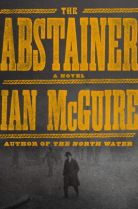
The AbstainerI’m always looking for absorbing thrillers, well-written and with something to say about the human condition.  I just finished a good one: The Abstainer by Ian McGuire, a thriller set mainly in Manchester, England in 1867. It’s a dark story, filled with the pain of the long war between the Irish and the British. Themes of loss, regret, and betrayal, combined with beautiful writing kept me turning pages. I read it in two sittings.
James O’Connor, a policeman from Dublin, is sent to Manchester to help uncover the plans of the violent Fenian Brotherhood.  Personally, it’s his last chance to redeem himself from the alcoholism that wrecked his Dublin career. The British have just hanged three Fenians; they know there will be reprisals. At the same time, the Irish-American Stephen Doyle arrives in Manchester to plan the Fenian Brotherhood’s act of revenge. Doyle served on the Union side in the American Civil War and is well acquainted with death; he’s a cold-hearted, arrogant loner. His first task is to ferret out the informers in the group, then he’ll take revenge for the hangings.

It’s a classic face-off between two driven, intensely motivated men. McGuire takes the reader deep inside O’Connell’s head. All his colleagues know about his ignominious reassignment from Dublin. What they aren’t aware of is that he’s still grieving for his dead wife and son. Doyle, the Irishman bent on retribution, is also struggling with demons; it’s his anger that makes him so dangerous. The story is like a chess game: there are moves and countermoves; some are successful, some are thwarted. O’Connor recruits his nephew to infiltrate the Fenians and then spends sleepless nights worrying about his safety.

The absorbing aspect of the novel is O’Connell’s desperate interior life, which is matched by the dismal Manchester weather, with sky “the color of wet mortar.” I was stopped many times by O’Connell’s trenchant ruminations. Here, he’s worried about the safety of his nephew:

“It occurs to him…that if his son, David, who had died, had lived instead, this is what fatherhood might have felt like: this constant irritating fear, this sense that a vital part of your life is being lived elsewhere, in secret, by someone you may love but can’t possible trust.”

It’s writing like this that kept me reading despite the brutal story. The murderous hatred between the Irish and the British was no fiction; in the next century it would only get worse.

Clive James: Poetry and Unreliable Memoirs

Unreliable memoirsOn Sunday mornings, my Israeli friend Pnina emails me the “Bookmarks” newsletter from the Guardian. It’s a lively roundup of new books and literary essays. Sometimes I just need to skim it and sometimes I find real treasure.

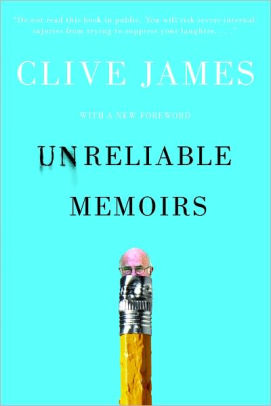
The treasure I found on Sunday was a piece by Clive James, who died in 2019. James was a well-loved (Australian-born) British literary and cultural critic. I discovered him for myself about fifteen years ago when I was putting together my book on memoirs. I found his first memoir, called Unreliable Memoirs and I loved it from the first page. Here’s what I wrote about it:

James pens a hilarious account of growing up in Sydney, Australia, in the 1940s and 1950s, son of a widowed mother who despaired of ever seeing her son make something of himself. His childhood was filled with mischief and over-the-top exploits at school and in the neighborhood, all of which hid his frantic adolescent need for acceptance and sexual conquest. A laugh out loud coming-of-age story with a strong sense of place and time.

 James went on to disprove his mother’s bleak view of his future by becoming a prolific author of literary criticism, poetry, memoir, and novels. He was a popular TV reviewer on the BBC, where his deadpan humor endeared him to listeners. It’s still in print to purchase but maybe your library has a copy of Unreliable Memoirs tucked away on a dusty autobiography shelf or you can find a secondhand copy; I highly recommend it. 

The Guardian article is an excerpt from James’s last book, Fire of Joy, about his lifelong love of poetry, which began with compulsory memorization of poems in elementary school. James didn’t find it difficult or unpleasant to memorize poems; he comments that “it was a fantastic combination of Parnassus and a maximum-security prison.” He goes on to write about the nature of poetry’s appeal and includes some of his favorite poems. His frank opinions, leavened with humor, make the excerpt a joy to read.

About poetry he writes, “With a poem the most important thing is the way it sounds when you say it. At that rate even the most elementary nursery rhyme has it all over the kind of overstuffed epic that needs 10 pages of notes for every page of text, and reduces all who read it to paralysed slumber–or even worse, to a bogus admiration.” (Is that why I’m such a fan of the “Jabberwocky?”) 

There are links at the bottom of the Guardian article to other articles about James, all of which sound wonderful. 

As best I can tell, Fire of Joy has not yet been published in the U.S., so the excerpt in the Guardian will have to suffice for now. I’ll keep an eye out for publication here.