Monthly Archives: March 2020

Help From Birds

birdI read Shelf Awareness Pro every day to keep up with the news from the book world. Lately it’s equal parts heartening and disheartening. This morning there was an obituary for Molly Brodak, a poet and author of a memoir about growing up with a father who robbed banks to pay his debts. The obit included a poem from Brodak that seemed just right for today so here’s an excerpt below. I had terrible dreams .last night filled with crime and sadness, fueled, no doubt, by anxiety about the virus, so the poem was helpful. Maybe it will be helpful to you.

An excerpt from Molly Brodak’s poem “In the Morning, Before Anything Bad Happens“:

I know there is a river somewhere,
lit, fragrant, golden mist, all that,
whose irrepressible birds

can’t believe their luck this morning
and every morning.

I let them riot
in my mind a few minutes more
before the news comes.

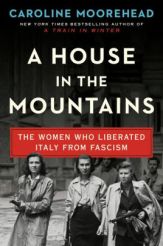
A House in the Mountains: The Women Who Liberated Italy From Fascism by Caroline Moorehead

House in mountainsMarch is a good time to read about brave women! I’ve been reading A House in the Mountains by Caroline Moorehead. The story Moorehead tells about women in the Italian Resistance is little known which makes it all the more fascinating.

Here’s some historical background: In 1943 the Italian military was in tatters, suffering defeat after defeat. They had lost the war in North Africa and Hitler was now expecting more Italian participation on the Eastern Front. The Allies were bombing Rome for the first time and were already in Sicily, preparing to fight their way north. In June, 1943 Mussolini’s council of advisers deposed him and set up an anti-Fascist regime headed by Marshal Pietro Badoglio. Through the summer, while pretending to continue the alliance with Germany, Badoglio negotiated a truce with the Allies. Chaos was unleashed. Germany turned on Italy and occupied roughly the northern half of the country, including Rome. The Germans found Mussolini and installed him as the head of a puppet government. The reinstated Fascists were vindictive, joining the Nazis in hunting down anti-Fascists and Jews, killing them or sending them to the camps. The Badoglio government was still functioning but the country was in shambles. Food was scarce and so were jobs.

It was in this chaos that Resistance groups formed. Moorehead tells the story of the women who were active in the resistance in Turin and the rugged mountains of the Piedmont. It was in this mountainous area of northwest Italy that anti-Fascists of various political persuasions banded together for acts of sabotage. They were united by their hope to return Italy to a pre-Fascist state. What would come after the war–what form that state would take–was yet to be determined. Resistance group politics ranged from the left (Communists) to the right.

The women in the Resistance groups were known as staffete; they carried messages, ammunition, food, and medical supplies. They spied on the German army, relaying troop movements and charming soldiers into providing information. They printed underground newspapers and bulletins. Like the men, many were captured by the Germans, tortured and killed, but their numbers increased through 1944 and 1945. Desperate and patriotic, these Italian women were determined not to be left out of the fight. Their lives are inspirational and I read the book in haste, hoping that they would all survive.

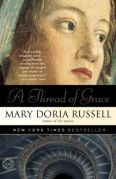
thread of graceMoorehead’s book reminded me of the novel: A Thread of Grace by Mary Doria Russell, published in 2005. A Thread of Grace is set in the same time frame and also in the Piedmont but it focuses on the French Jews who traveled to Italy over the Alps when Italy broke with Germany. They were hoping for a safe harbor from the Nazis but found something quite different. It’s a moving account of the intersection of the lives of Catholics and Jews; Germans, Italians, and French; Fascistis, anti-Fascists, and Nazis at a time when making life and death choices was their daily bread.

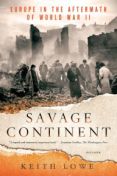
savage continentI was also reminded of Savage Continent: Europe in the Aftermath of World War II by Keith Lowe, a chilling account of what happened after the War, when ethnic cleansing, revenge, and displacement made Europe a nightmarish place well into the 1950s. Resistance groups, governments in exile, and former political leaders all wanted to shape the new governments and reset boundaries. The British and Americans had their own agenda–to obstruct the Communist influence–the USSR clearly had another. It’s a cautionary tale for all of us about how  ending a war sometimes signals the beginning of another kind of conflict, often just as deadly.

Sheltering in place is a good time to read something challenging, something absorbing. I’ve spoken to friends who are having a hard time focusing their attention on anything other than the news about the pandemic. Any one of these three books would be a good choice for distraction. I am aware, however, that many libraries and bookstores are closed so it’s harder to get the books you need. I’ve been reading e-books and listening to audiobooks. Log into your local library and see what you can find!

The Controversial Semicolon

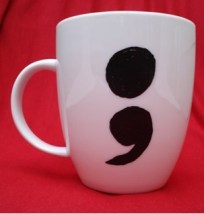
Semicolon2I subscribe to the daily literary news blog Lithub. For those who don’t have this particular addiction, Lithub gathers links to news from around the globe about writers and writing. There are links to articles about writing, literary prize announcements, interesting book reviews, and other assorted oddities. I scan it in the morning and sometimes there are 3 or 4 articles of interest to me; sometimes none. I can’t give it up, fearing that I’ll miss something really wonderful since it celebrates good, interesting writing and the lives of writers.

While we’re all isolated, during this time of Covid-19, we ought to have more time to read, so here’s a link to an article I enjoyed about good writing that I first found on Lithub. Ignore the fact that it’s about semicolons if that doesn’t seem appealing. A good writer can make anything appealing, and Adam O’Fallon Price succeeds here. The opening of the article will grab you immediately. It’s a quote from Kurt Vonnegut:

Here is a lesson in creative writing. First rule: Do not use semicolons. They are transvestite hermaphrodites representing absolutely nothing. All they do is show you’ve been to college.

Hah! You’re hooked, yes? The article is much more than you think it will be. It’s not a screed about the dastardly semicolon; it’s about good writing and how punctuation can take it to a higher level. The samples of writing from great authors illustrate that point. (Full disclosure: I love semicolons and use them often to change the flow of a sentence.)

Here’s the link to the article:

On Semicolons and the Rules of Writing by Adam O’Fallon Price from The Millions, July 10, 2018


Frederick Law Olmsted

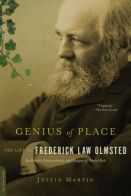
Genius of placeThe last book my non-fiction reading group discussed was Genius of Place: The Life of Frederick Law Olmsted by Justin Martin. We had a good discussion about FLO, as he’s frequently known, since his energetic, and contentious life touched and influenced many of the innovations and changes of the nineteenth century. He’s best known as the landscape architect of New York’s Central Park, but he left behind an extensive legacy in other fields as well. In fact, he created several fields of study and practice. 

Olmsted was born in Hartford CT in 1822; his father was a prosperous merchant and FLO grew up in comfortable surroundings. Like many young men–then and now–he wasn’t at all sure what he wanted to do. He tried attending Yale, like his older brother, but he dropped out after a few months. It’s likely that an episode of hysterical blindness may have been the cause. He went to sea as a sailor to see the world, but quit after one voyage; the privations of the sailor’s life were not for him.

Even at an early age he had a strong desire to be a social reformer and his love of the outdoors turned him in the direction of farming. He wanted to improve agricultural practices and apprenticed himself to an experienced farmer in upstate New York. After a year, convinced that he had all the expertise he needed, he purchased a farm in Staten Island with the help of his father. For a while he was successful, but ultimately abandoned farming for journalism. In 1850, when the issue of abolition was dividing the country, he was uncertain about his own opinions and undertook a trip through the South to see conditions firsthand. To finance the trip, he obtained a commission for a set of articles from the the New York Daily Times (now the New York Times).  The extensive and insightful dispatches that he wrote are still a valuable resource for historians. The result, for Olmsted, was that he became convinced of the importance of the abolition of slavery.

When the Civil War began, he became the director of the U.S. Sanitary Commission, precursor to the Red Cross. Later, for a few years, he was the administrator of the Mariposa gold mine in California. While in California, he visited Yosemite; stunned by its beauty, he became an advocate for preservation of the park in this era before the concept of national parks.

All of these experiences prepared FLO for his career as a landscape architect. There was no such profession in the mid-1800s but Olmsted was never reluctant to be the first to do something.  Central Park was his first commission, with partner Calvert Vaux, and already Olmsted had strong feelings that parks should be for the people. The site for Central Park was a wasteland, partially filled with squatter’s huts. Thousands of workers were hired and Olmsted put them to work clearing stones, grading, planting thousands of trees, and building stone walls. The roadways through the park were placed below ground level so they didn’t intrude on the beauty of the landscaping and the carefully  designed vistas. His experiences in agriculture and administration were essential in the success of this first project. Olmsted went on to design significant parks in Boston, Chicago, Buffalo, and his designs played a significant role in the magnificent World Columbian Exposition in Chicago in 1893. His designs and philosophy affected parks all over the U.S.

Olmsted’s energy was unflagging until his last years, despite a leg injury that caused him pain through most of his adult life. Martin, the author of this biography, makes a case for bipolar disorder as a source of his furious activity. While we can never know for sure, FLO’s life displayed so much energy and endurance, as well as periods of serious mental ups and downs, that it may indeed be the case. Whatever the reason, we’ve been the beneficiaries. If you look at the website for the National Association of Olmsted Parks you’ll see the list. Genius of Place, while it aims to be a definitive biography, is also a joy to read and I recommend it highly!


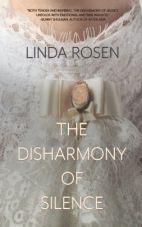
The Disharmony of Silence by Linda Rosen

Disharmony of silenceI haven’t read this novel yet, but since the author is a good friend of mine, I wanted to share the news of its publication. The Disharmony of Silence comes out tomorrow, March 5th, and Linda is already signed up for a blog tour, details about the book and the blog tour are on her website.

Family ties, grievances new and old, second chances at happiness all fill the novel. Here’s the publisher’s description:

“In 1915, jealous, bitter Rebecca Roth cuts all ties with her life-long friends, the Pearls. Eight years later, Rebecca’s son and young Lena Pearl begin keeping company in secret. Rebecca agrees to a truce when the couple marries. But the truce is fragile. Rebecca’s resentments run deep.

In 2010, Carolyn Lee, fitness instructor and amateur photographer, must come to grips with the fact that her mother’s imminent death will leave her alone in the world. While preparing her childhood home for sale, she realizes for the first time that her mother’s antique brooch is identical to the one pinned to the lady’s dress in the painting hanging above the fireplace. Coincidence or connection? Carolyn is determined to find out. What she discovers has the potential to tear lives apart or to bring her the closeness and comfort she longs for. It all depends on how she handles her newfound knowledge.”

The publisher is Black Rose Writing and you can order the book the usual way–from your local bookstore, bn.com or amazon.com either as a hard copy or an ebook.