Monthly Archives: June 2015

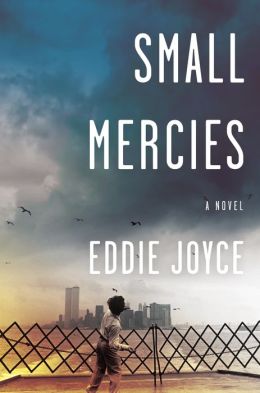
Small Mercies by Eddie Joyce (Penguin)

Small MerciesI loved this family story, a first novel that’s full of life and characters that live beyond the page. It starts off slowly, building the reader’s relationship with the Amendola family, especially Gail, the Irish girl from Brooklyn’s Bay Ridge neighborhood, who married into an Italian Staten Island family and learned to live with the rules of the culture she adopted, for  better or worse.

The novel takes place over the course of one week, but with a generous use of flashbacks we learn all about the Amendolas, what they think and feel. Wife Gail and her retired firefighter husband Michael had 3 sons, but the youngest, Robert, also a firefighter, was killed on 9/11. It’s now 10 years later, but the family is still reeling from the loss as they prepare for the birthday celebration of their grandson Bobby, Jr., this small son of their own youngest son, who has never known his father.

I always hope that the first pages of a novel will  tell me something wonderful about what to expect in the way of the writing. Each chapter in Small Mercies is told from the point of view of a family member, and on the second page, in a chapter told from Gail’s perspective, I found the nugget that let me know that I was in the hands of a great storyteller. Gail’s on her way out: “A quick look in the mirror. Not for vanity, not anymore, but for its older sister: dignity.” Brilliant. Joyce has something to say and says it well.

The Amendolas are part of a close-knit culture of Italians and Irish in Staten Island; what one character calls “the servants’ quarters of the city.” They share the neighborhood rituals and enthusiasms: liquor and sports anchor this community. There is some chafing at expectations: oldest son Peter couldn’t wait to get out and as a teenager rode the ferry to Manhattan to remind himself of where he wanted to be. But even as a successful lawyer, with a WASP wife, he’s unable to shake the feeling he’ll never fit in. Middle son Franky never recovered from the death of his younger brother and turned to alcohol to anesthetize his grief. Bobby’s widow, Tina, still tied closely to the Amendolas, wonders if 10 years is long enough to be a single mother as she starts to date. Gail and Michael have their own issues to work out and there’s reference to the ways they pleased and disappointed their own parents.

Joyce brings us into the thoughts of these characters and some terrific minor folks as well. He clearly loves them all. I enjoyed the structure, which allows him to introduce depth and reveal backstory. Each chapter is told from the point of view of a single character, but these alternate with Gail’s chapters, always coming back to her experiences and point of view. As the reader moves through the novel, hearing each characters’ thoughts, the characters become more rounded, more alive, and the story becomes more emotional and revealing. It’s an example of how domestic fiction, in the hands of a good writer, can be completely absorbing.

The Sunlit Night by Rebecca Dinerstein

The title refers to the setting of this novel in the northernmost part of Norway, in the summer, where two unlikely Americans meet at a Viking Museum. I need to back up to set the scene for this unusual, affecting story.

Francis, a young artist, has just broken up with her boyfriend, who tells her that painting is of no use to the world: “What you do doesn’t help anybody.” Other parts of Francis’s life are broken: her parents are divorcing and her younger sister Sarah is getting married to a man that her parents dislike. Everyone is unhappy. Francis has the opportunity for an internship in Lofoten, a group of islands 95 miles north of the Arctic circle and it seems like the right time to get away. She’ll be working on something called the Yellow Project.

Yasha, a young man of 17, lives with his father in Brighton Beach where they own a bakery. Their lives are broken, too. Yasha and his father Vassily immigrated from Russia 10 years ago, but Yasha’s mother never followed them and refuses to communicate with them. They both miss her terribly and after Yasha’s high school graduation they decide to return to Russia to find her. Vassily suffers a heart attack in Russia and Yasha, according to his father’s wishes, takes his body to–you guessed it–Lofoten, to bury him as he wished. In the time Yasha spends in Lofoten, he finds much more than he ever imagined–he grows up, for one thing.

The joy of reading this unusual novel is in Dinerstein’s writing, which is circular, elliptical, and utterly captivating. She manages to convey the way we think and converse–the serious and mundane things that crash about simultaneously in our heads; the emotions we can’t or won’t convey; and the feelings of loss and loneliness that we all share. The setting and supporting characters are delineated in a few quick strokes, but their voices are unique.

The Turner House by Angela Flournoy (Houghton Mifflin Harcourt)

Turner HouseThis is a terrific family story, combining compelling characters and social history.  Flournoy does a great job of creating fully rounded characters–even the siblings that appear only briefly are real people. I suspect (and hope) she has more stories about the Turners  that didn’t make it into the novel.

The Turner family has lived on Yarrow St. in Detroit for over 50 years. Francis and Viola raised 13 children there and witnessed the precipitous decline of the city’s East Side. Widowed and elderly, Viola is now in danger of losing the house, which is worth less than the mortgage payments. Her children and grandchildren have strong–and different–feelings about whether the house should be saved.

From the oldest–Cha-Cha–to the youngest–Lelah–everyone weighs in with an opinion or a plan, depending on what the house means to them. Cha-Cha feels responsible for making decisions and providing for his mother; he irritates his younger siblings with his need for control. Lelah, the youngest, is secretly living in the old house; she fears that her brothers and sisters will learn about her gambling addiction. Troy, a policeman, has a scheme to make money by selling the house illegally. Turner focuses on these and several other siblings but we get a terrific sense the family dynamics. With all these stories and family collisions, there’s also a subplot about a “haint” that appeared to Francis and now Cha-Cha. The meaning of the “haint” is unclear to Cha-Cha, and he worries that it’s providing a message that he needs to understand. Turner cleverly doesn’t let the “haint”  turns the novel into a ghost story, but uses it as a device to reveal some of the dark undercurrents in the family’s history.

Flournoy’s descriptions of the Turner family dynamics and the house that holds them together is filled with the family dynamics we all know; it’s a universal story of how we love and struggle with our parents and siblings.