
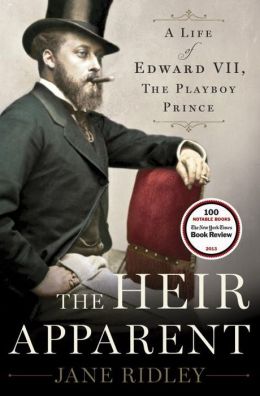
 I’m hoping to read more European history this year and have just finished The Heir Apparent: A Life of Edward VII the Playboy Prince by Jane Ridley, the new bio of Queen Victoria’s philandering son, who gave his name to the Edwardian era, the first decade of the 1900s.
It’s a huge book, and my thought was that I’d start reading and maybe not finish it, but I was riveted. Ridley has the wonderful facility of making masses of detail fascinating. She’s also managed to let you know that she’s there with you as you’re reading without really interposing herself.
There’s a cast of hundreds, since Bertie had a wildly active social life, and the reader can only turn the pages in disbelief as “Wales” (as he’s often known) gets into one scrape after another, rescued and shielded by his loyal staff. Even the Prime Ministers protected Bertie from disgrace. I was unaware how much anti-royal sentiment there was in Britain of the late 1800s; Queen Victoria wasn’t sure that the monarchy would survive her and it’s not clear that she cared. She didn’t believe that Bertie would make a suitable king and he never received the appropriate education and training. She was unwilling to relinquish an iota of power or monarchical privilege to him and was jealous of any success he had with the British public or overseas.
But when Victoria died in 1901 he rose to the occasion, although he regretted that the great opportunity came so late in life. Part of the fun of the book is re-visiting the convoluted relationships among the royals in Europe and Russia–so many were Victoria’s descendants and it affected late 19th and early 20th century politics in very interesting ways. For more about those relationships, I recommend reading King, Kaiser, Tsar by Catrine Clay.

 A Reader's Place