Monthly Archives: March 2010

Immortal Cells

The Immortal Life of Henrietta Lacks has received lots of wonderful press and will probably appear on many “best” lists at the end of the year. There’s a good reason: it’s quite special; an engaging human interest story that combines personal history and medical history. Henrietta Lacks, in case you haven’t picked up on the press for Rebecca Skloot’s book, was an African-American woman living in the Baltimore area, whose cancerous cells, by their amazing replicative abilities, helped drive advances in medical science via cell research.

All of our lives are better because of Henrietta Lacks’s unknowing contribution. That’s the problem; neither Lacks nor her family were aware that she was donating her cells. it wasn’t until 20 years after her death that her daughter discovered–by accident–that her mother was famous as the HeLa culture, found in labs all over the world, a source of profit for the companies that manufactured it, and the subject of conferences and controversies.

Skloot makes all of the science accessible, introducing us to the scientists she met during her research and their conflicted relationship with HeLa. Beyond the science, she tells the story of the Lacks family and their struggle to understand and come to terms with the appropriation of Henrietta’s cells. In addition, Skloot tells us how she got the story, overcoming the resistance of the Lacks family to talk to yet another intrusive white person about Henrietta. The combination of science, family history, and Skloot’s personal involvement works on all levels. It’s a wonderful tribute to a woman who’s been anonymous for far too long.

The heart of the story is the issues it deals with: medical research ethics, racism, cancer, and poverty. Skloot makes these isues personal and compelling. There was no informed consent in the early 1950s, when Henrietta’s cancerous cells were appropriated by a researcher. Skloot writes about the debate over the ownership of human tissue; despite the myriad of forms we sign in doctors’ offices and hospitals, you may be surprised with what she reveals.

I would be remiss if I didn’t mention that Rebecca Skloot is the daughter of another wonderful writer: Floyd Skloot. I particularly recommend In the Shadow of Memory, a wonderful memoir–in-essays about illness (his own). Skloot is one of the most elegant, graceful writers I know.
Explosions

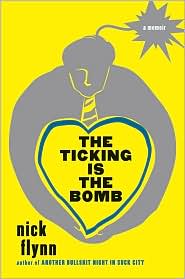
Some of the most compelling memoirs don’t follow the rules–I’m thinking of Nick Flynn’s The Ticking is the Bomb, which I read in one great gulp yesterday. Flynn’s narrative may be episodic, but he leads you straight to the heart of his life and the things that make him tick–and burn.

While Flynn is waiting for his first child to be born, the photos of torture committed at  Abu Ghraib prison are released. The book explores the coexistence of these two events, which define the heaven and hell of human behavior. His daughter Lulu brings redemptive love into his life, a fresh start, a chance for a stable family life to follow from his own shattering history. The Abu Ghraib photos, with their mockery of human interaction bring out a white-hot passion in Flynn. He goes to Istanbul with a group of lawyers and artists who interview Abu Ghraib survivors and collect their testimonies. 

In this riveting memoir, we do learn about Flynn’s childhood, his struggles with drugs, alcohol, and relationships, but those facts are not the point, or, they’re only part of the point. Flynn’s short chapters fly off the page at the reader, forcing us to make connections between the ordinary and the unthinkable.

There are several other unusually good episodic memoirs that I’ve recently read and enjoyed:
Jennifer Brice. Unlearning to Fly University of Nebraska Press, 2007.
Michael Chabon. Manhood for Amateurs: The Pleasures and Regrets of a Husband, Father, and Son. Harper, 2009
Michael Greenberg.  Beg, Borrow, Steal: A Writer’s Life. Other Press, 2009.
Floyd Skloot. In the Shadow of Memory. Bison Books, 2004.

A great Booklist review for my book…

Last Friday I was delighted to learn that the March 1st issue of Booklist has a review of my book Read On…Life Stories.  To avoid bragging, I’ll just say that the review definitely made my day. Here it is:

“Who sits around and reads a bibliography? Unlikely as it seems, pretty much anyone who picks up this entry in the Read On . . . series. For all those who enjoy reading memoirs, the 450 cogent annotations in this collection offer a wealth of options. The book is divided into five sections by defining characteristic—“Character,” “Story,” “Setting,” “Language,” and “Mood”—and more specific subsections further narrow the type of memoir. Categories include “Passage to Adulthood: Coming-of-Age Memoirs,” “Dishing: Stories from the Kitchen,” and “Taking It on Faith: Spiritual Journeys.” The recommended authors range from the absolutely classic (Mark Twain) to the contemporary (Augusten Burroughs), and all are annotated in stylish, attention-grabbing prose that could sell pretty much any book. Like others in the series, this is a readers’-advisory title that could be handed off to patrons to browse on their own—if you can get it away from the librarian. With both a detailed table of contents and an excellent index, this is a must-have tool for public libraries.” Ann Welton